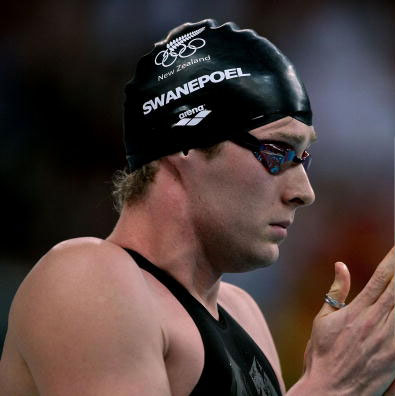
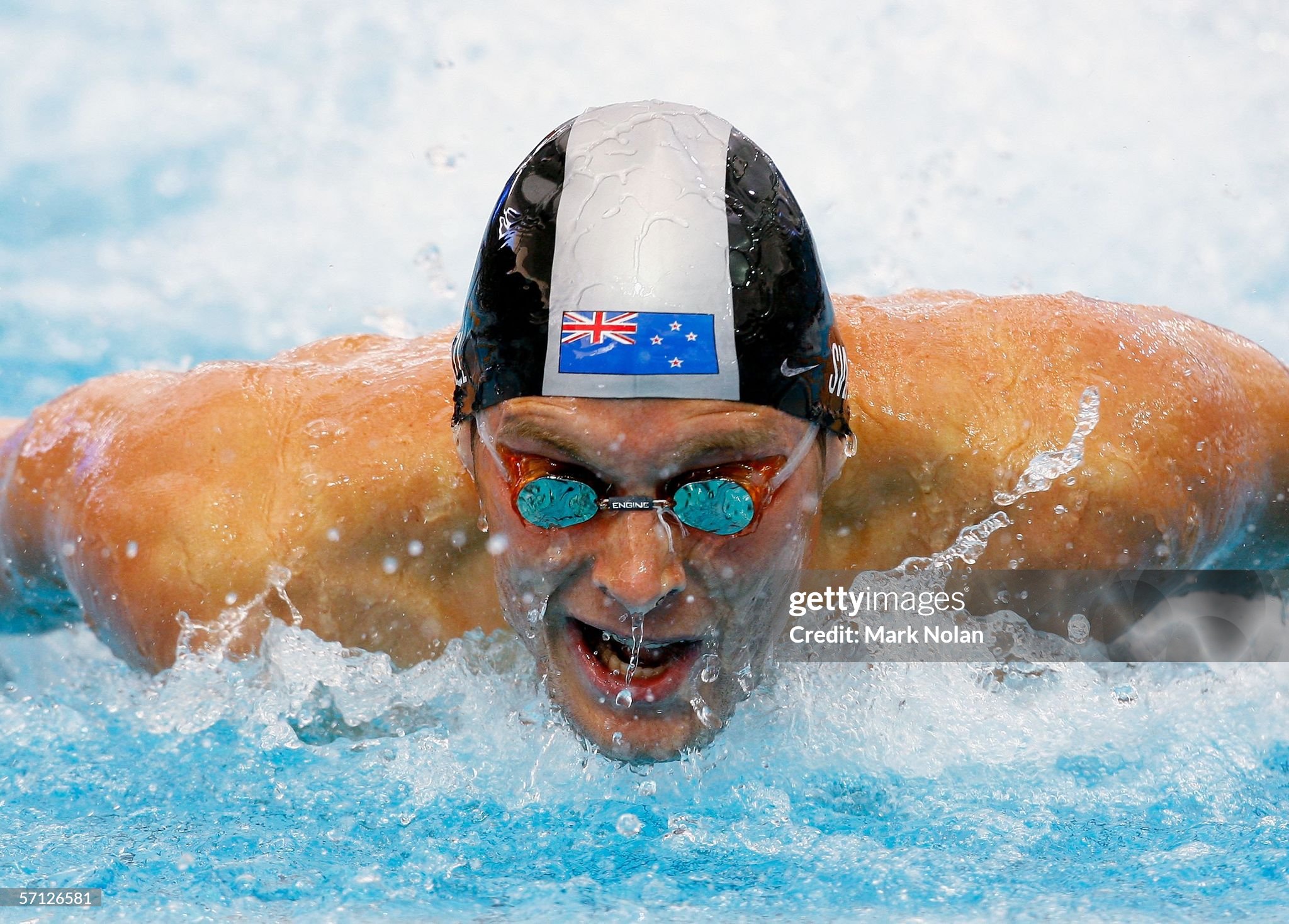
Corney Swanepoel (born 17 March 1986 in Potchefstroom, South Africa) is a butterfly swimmer from New Zealand. He swam for New Zealand at the 2004 and 2008 Olympics. At the 2008 Olympics, he swam the 100 fly, where he finished 12th, and swam on New Zealand's 5th place finishing 4x100 medley relay.
In 2024 Corney still holds the New Zealand Records in the 50m Butterfly (both long course and short course) and 100m Butterfly (both long course and short course), set in 2009. With fellow South African Glenn Snyders, they are half of the New Zealand team record holders for the 4x100 medley relay.
Swanepoel making waves
April 2, 2009
Corney Swanepoel was born 23 years ago in Potchefstroom but these days represents New Zealand. So, as much as Corney Swanepoel sounds like the SA-born swimmer he is, it’s the Kiwis who are benefiting from his talent.
The New Zealander stormed to a national record victory in the men’s 100m butterfly at the New Zealand championships, where Rome 2009 world-championship trials were held in Christchurch. Swanepoel turned in 24sec on his way to a 51.61 victory ahead of fellow Olympians Moss Burmester (51.99) and Daniel Bell (52.28). It was the third fastest time in the world this year. I had done absolutely no ‘fly until five weeks ago. For the last five years I have been concentrating on the 100m butterfly race so it can get a bit much after all that time,” Swanepoel told NZPA.
So I wanted to refresh myself and basically with my coach Thomas Ansorg we have changed just about everything. As well as doing more freestyle we have done less mileage and more power stuff. Mentally it’s really refreshing.┬á When you do something new there’s an element of risk so I was a bit nervous tonight. It’s exciting to get this result. Now I can go back and work in this, do some hard work to help with the back end of the race. I am pretty excited about this swim.”
The South African record stands at 51.90, established by Lyndon Ferns at the last FINA World Championships. Which goes to prove that Swanepoel and his 51.61 is unfortunately New Zealand’s gain and South Africa’s loss.
Swimming: Corney Swanepoel, a key medal hope
22 Jul, 2004
IN THE winter of 2002, Swanepoel was a teenager growing up in Cape Town, happy in his boys' school, thriving at the Vineyard swim club. Swanepoel had been swimming since he was 9, starting with the Dolphins club in his hometown of Potchefstroom, in the gold-mining heart of South Africa.
He threw himself into all swimming strokes, except butterfly - sitting on the side of the pool, stubbornly ignoring the pleas of his coach to give it a go.
Every Saturday, the little Dolphins would travel to a swim meet in a different town, and Swanepoel would struggle to do one 50m length in butterfly. His mother, Cindy, remembers how three-quarters of the way down the pool, Corney would splutter and choke and have to walk his way to the side.
His parents squirmed in the stands when Swanepoel lined up in his first 100m fly race - knowing he had never made it to 50m. Yet it became the defining moment in Swanepoel's career.
"When the whistle blew to get up on the starter blocks, Corney was the only one up there - he was the only entry," Cindy says. "He swam the first 50, then turned and swam home. When he touched the wall, he looked up and said, 'Oh wow, I finished!' And everyone in the crowd stood up and clapped and cheered.
"Everyone knows Corney is easy-going, but his other strong characteristic is his extreme determination."
From that race, Swanepoel found his wings. He developed an exceptional technique and perfect rhythm in the most demanding of swimming disciplines.
And his coaches soon discovered he had that rare "feel" for the water that a select few swimmers possess. It's about not just dipping a hand in the water, but naturally feeling your way through it. Danyon Loader had it; swimming's latest superstars, Ian Thorpe and Michael Phelps, have it too.
"It's hard to explain, but instead of just pushing your arms through the water, you're pulling yourself over the water," Swanepoel says. "I don't think about it, it just happens."
In 2002, Swanepoel was setting South African national age-group records in butterfly, some of which still stand today, and representing his country for the first time. He was happy under the coaching of former Hungarian waterpolo star Karoly von Toros, a big-voiced, bare-chested man, who had already coached Sarah Poewe to become the world short-course breaststroke champion.
Then Swanepoel's parents - Faan, an Army officer, and Cindy, a university registrar - suggested the family move to New Zealand, where there were better work and education opportunities for their three sons.
The Swanepoels had friends who had successfully emigrated to the South Island two years before. Corney and his two older brothers were not impressed.
"Naturally, when Mum and Dad broke the news to me that we were moving to New Zealand, I was upset. I didn't want to leave," Swanepoel says.
Cindy admits it was a heart-wrenching decision to take her reluctant sons away from their home and their friends. "They were apprehensive, and that's totally normal. But we wanted to give them the best opportunities, and we didn't consider anywhere else but New Zealand."
Rather than poking a pin at a map, the Swanepoels asked von Toros to find them the best swimming coach in New Zealand, and that is where they would settle. Von Toros threw up just one name - North Shore swimming sage and New Zealand coach Jan Cameron.
He emailed Cameron, letting her know one of his best young swimmers was moving to New Zealand. "And I said, 'Thank you very much'," says a grateful Cameron. The two coaches are now in email contact every time Swanepoel swims.
The family set up home in Browns Bay. The North Shore bays are a popular community for South Africans, but the Swanepoels say they moved there because it was close to the Millennium Institute, where the North Shore Swimming Club is based.
At first Swanepoel was a quiet member of Rangitoto College, which borders the Institute grounds, but his teachers say it took only a couple of weeks for the charm and self-confidence to come bubbling to the surface.
Barely a hint of a South African accent remains, and his preferred footwear is a pair of good old Kiwi Jandals. Summer or winter, Swanepoel goes to school dressed in his shorts, Jandals, hoodie and sunglasses - just one of the seventh form crowd.
"He's had no trouble making friends here," says teacher Dave Mackay. "Most people would know who he is, and that's quite an achievement in such a big school."
As much as he wanted to blend in, Swanepoel grabbed the chance to make his name known throughout New Zealand. Within five months of arriving he was smashing long-standing national butterfly records with a swat of his hand - the 16-age-group time set by Loader, then Olympic bronze medallist Anthony Mosse's 14-year-old 100m fly record.
Next thing he was being talked of as having the potential to become one of New Zealand's great swimmers.
The dipping sun streams into the Millennium pool, the floor is awash and slippery, the air a tangy mix of chlorine and teenage hormones.
Swanepoel's arms slice through air and water with perfect symmetry. One second he is almost wholly above the water, arms stretched like a hovering gull, the next he is fully submerged.
Whenever Swanepoel has his head above water long enough, he is talking, joking, and pushing his mates, who are racing against stopwatches in the hands of Jan Cameron and fellow coach Thomas Ansorg. "The talk is my way of trying to blot out the pain," Swanepoel says, with a half-grin, half-grimace.
"The swimming is tough - they don't take it easy on us. We've got to do really high mileage to get a good base behind us before we go to Athens, so we are really killing ourselves right now."
Training is twice a day, with school sandwiched in the middle. Swanepoel swims from 6am to 8am, and has breakfast at the pool before driving himself to school.
By no means is Swanepoel stuck on a scientific nutrition programme leading up to the Olympics. "I like to have a couple of pies and a Coke for breakfast," he says. You quickly understand that pies - steak and cheese, butter chicken, or apple and custard - are as big a part of this athlete's life as chlorinated water.
After a gruelling training session, he will walk into class chewing on a long stick of french bread. He needs the fuel: "Sometimes I struggle to keep up my concentration in class."
Swanepoel is Rangitoto College's first in-house Olympian, so the school and the student are feeling their way through this new relationship. The school has allowed Swanepoel to do just three subjects - maths, physics and English - in his bursary year, which lets him do the bulk of his homework in school time, before his afternoon training session.
Next year, he plans to study for a degree in aviation at the nearby Massey University Albany campus. When swimming is done, he wants to be a pilot.
"School has been cool. The teachers hold work for me when I go overseas, but I've had to get a maths tutor to keep up," Swanepoel says.
His teachers are impressed with the way this boy, the fastest 18-year-old butterflyer in the world, handles the load he has to carry.
"He's so relaxed at school - all the pressure doesn't seem to get to him. You see other teenage athletes who put so much pressure on themselves and they don't cope," says Dave Mackay. "There have been a lot of demands on him, yet he's doing well at school, and doing exceptionally well in the pool. I think it's his whole mentality - he knows what he has to do."
Jan Cameron, who saw the champion in Swanepoel within weeks of him arriving in New Zealand two years ago, can't let up on her Olympic squad now, a month out from Athens. And even though Swanepoel is still a schoolkid, he is in no way mollycoddled to get through this.
"He has all the ingredients," she says. "He has the talent, the smarts, heart, receptiveness and perspective. It's a long journey and you have to have a wide view of the world - get through school, have friends. Some people have it innately, and Corney has.
"Of course, he's a teenager, so every now and then we have to give him a thump on the head. But more than anything, he's a charmer."
Oh yes, it seems he has the sometimes stern Cameron wrapped around his little finger. How else could you explain her cooking his breakfast eggs when they were in camp in Australia? "I just had a sad face on that morning, and Jan felt sorry for me, that's all," he says.
It is obvious that Cameron is taken with Swanepoel's attitude - as much as he is easy-going and a bit of a clown, he has set serious, resolute goals, which you have to believe are achievable.
"I want to be an Olympic gold medallist," he says, boldly. "If not at these Games, then definitely the next. And I want to hold the world record. I know it's a big call, but that's what I want."
That's just what Cameron lives to hear. "I suppose it's the reason you coach at this level - to hear that. When they say it, you think, how can we help them do it, and it keeps you interested as a coach," she says. "It's easy for the young ones to say when they don't realise how hard it is. But I've had two swimmers tell me that in the last two months. And I think it's fabulous."
Cindy and Faan Swanepoel, who call the coach his "second mum", are happy to entrust their youngest son to Cameron. For seven years, they paid for Corney's swimming career, drove him to and from trainings twice a day; left their jobs and friends in South Africa to give him a better chance of success in another land.
So far, they say, their sacrifices have paid off. And now that he has reached the top echelon of the sport in New Zealand, they no longer have to financially support Swanepoel's swimming.
"That's one of the things we love about New Zealand," says Cindy. "They really invest in their sportspeople. South Africa just doesn't have that type of infrastructure."
Swanepoel is a carded athlete, meaning he receives a personal grant from Sparc (Sport and Recreation New Zealand), and has scholarships from the Millennium Institute and the Peter Snell Institute of Sport, which backs school-aged athletes.
Under the Government's Performance Enhancement Grants to be introduced in September, he will be eligible for help with his living costs as an internationally ranked athlete, and a Prime Minister's Scholarship for a free tertiary education.
On top of that, he has gained sponsorship from Regency Duty Free and Nike.
His older brothers are prospering here, too. Jacques, 25, is a marketing manager for an electronics firm in Auckland, and 20-year-old Stefan studied the arts before joining the New Zealand Army, and is now based at Linton.
Cindy and Faan can now afford tickets to Athens to watch their son compete in his 100m butterfly heat on August 19, one of the last days on the swimming card. He is hoping to compete on the final day, too, in the men's 4x100m medley relay.
Swanepoel's own excitement about the Olympics is palpable. "I just can't wait - walking in the opening ceremony, right in the thick of it. But that's all tempered by the work we have to do first," he says.
"The first thing I'm going to do is grab as many tickets to other sports as I can, so I can watch once the swimming is over. I really want to go to the women's beach volleyball," he says with a wink.
Don't worry that Swanepoel won't be steadfastly focused on what he is truly in Athens for. Since he swam 52.5s to qualify at the New Zealand nationals in March, breaking the national record as he went, Swanepoel's Olympic expectations have sharpened.
For months afterwards, his was the third-fastest time set around the world this year. Where his goal was once to make the Olympic final eight, he now reckons a top-five place is within his reach.
"It's been great motivation for training," says Swanepoel.
He will be up against two of swimming's rock stars in the Maroussi outdoor pool - Americans Michael Phelps and Ian Crocker. Phelps could be shooting for an unrivalled eight golds in Athens, but Crocker stole his thunder at last year's world championships as the first man to break 51s in the 100m fly.
At last year's world champs in Barcelona - his first taste of the big-time - Swanepoel had his wings clipped, finishing 19th. But it only made him want to soar higher.
"In Barcelona, I watched the final of the 100m fly, and there were 12,000 people all standing on their feet, going nuts. I just thought, next year I want to be in that final, I want to be part of that." He wants to hear the crowd roar for him once again, just like the 10-year-old who finally made it to the finish, without drowning.
Corney Swanepoel
Born: March 17, 1986, Potchefstroom, South Africa
Home: Auckland
Occupation: Student
Status: Single
Height: 1.85m
Event: 100m men's butterfly, (possibly 4x100m men's medley relay)
Olympic swimming competition dates: August 13-20 (NZ time)
CV: Ranked No 1 in world under-18 men's butterfly; 19th 100m butterfly, 2003 world championships, Barcelona; New Zealand open record holder 50m and 100m fly.
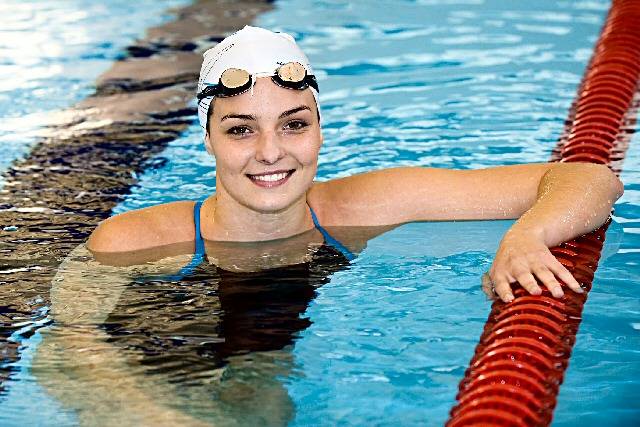
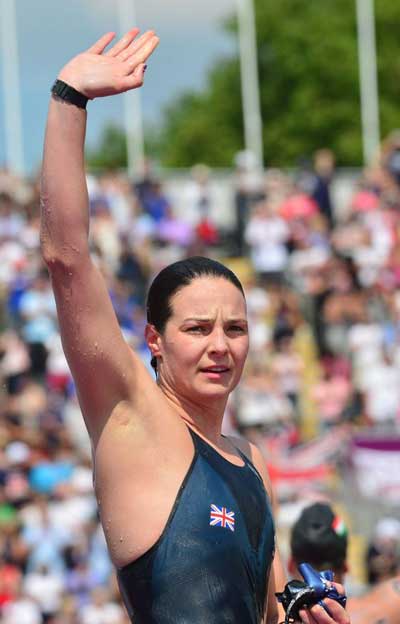
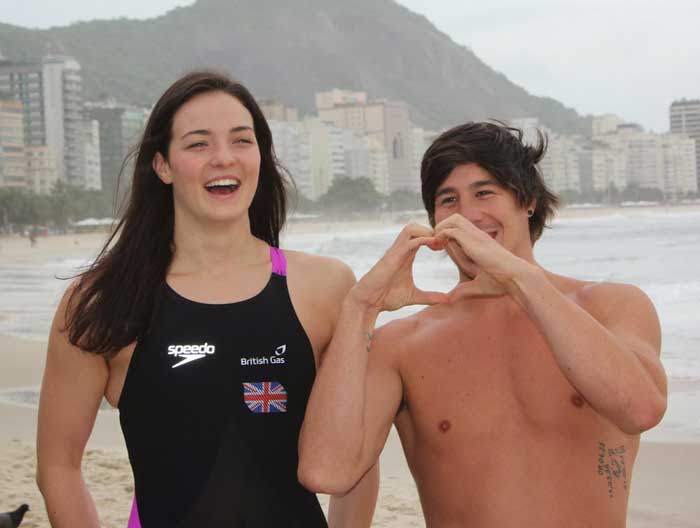
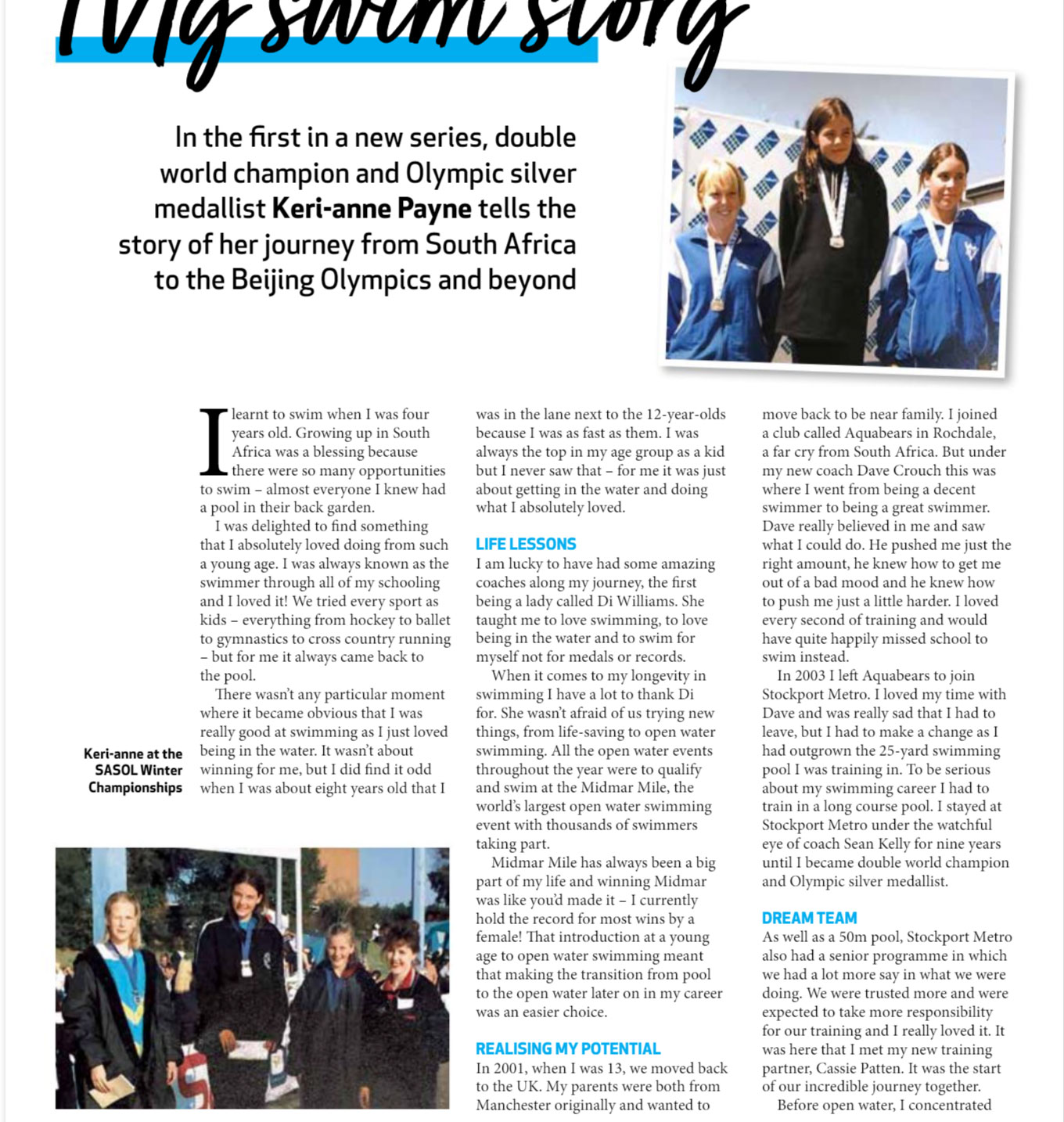
Keri-anne Payne is a two-time 10-kilometre open water world champion and an Olympic silver medallist in that event. At the 2010 Commonwealth Games in Delhi, she won bronze in the 400IM.
She was born to British parents in Johannesburg on 9th December 1987, where she lived until the age of 13.
British Performance Director of Swimming Bill Sweetenham was in South Africa at a training camp, where he encountered Kerri-anne. He assumed she was South African, but when he discovered she was British, he could not believe his luck.
Impressed by her natural talent, Sweetenham encouraged Payne’s parents to move back to Britain so she could get the best coaching, and, in 2001, the family settled in Heywood, Lancashire.
She made an impressive entrance to the international scene by winning the 400 m freestyle at the 2004 European Short Course Championships in the week of her 17th birthday.
Although she has competed in freestyle and medley between 200 and 1500 metres it is in the open water events that she has flourished. She placed 11th in the first World Championships in 2007 but improved her times considerably in the run-in to the Beijing Olympics and it was no great surprise that she took the silver medal at the event's Olympic début.
Payne then won the 10 km open water at both the 2009 and 2011 World Aquatics Championships and was voted the FINA Open Water Swimmer of the Year in both years. She also won a bronze medal in the 400 m individual medley at the 2010 Commonwealth Games.
Payne’s passion for the Midmar Mile
February 1st, 2013
British star Keri-anne Payne is the most successful swimmer in the history of South Africa’s Midmar Mile. At the official press launch of the 2012 edition of the world’s biggest open-water swimming event, the seven-time champion explained why winning it was so close to her heart.
Born in Johannesburg, Payne lived in South Africa until the age of 13 and had her first taste of the world’s largest open water swimming event before she relocated to the United Kingdom.
Yet her memory of winning the Midmar Mile 13-and-under title remains clear and a big highlight in her career. “It was my first win and my family was ecstatic,” she recalled at Wednesday’s launch in Pietermaritzburg.
“My dad’s done it [swum the Midmar Mile] something like 15 times, so it was always a really big family thing that we did. I love coming back because it’s such a good memory from when I was a kid.”
Then she revealed the motivation that has driven her since that time. “I remember my dad and brother telling me ‘well done, that’s really good’, but that Natasha Figge, I am not sure that there will ever be anybody as good as her and that was it.
“I decided I wanted to be better than her. I guess I can thank my brother and my dad for their love of Natasha Figge, for me pushing on and going for the most number of wins.”
As of 2012, Figge has six wins. Payne owns the record with seven. Usually, Payne, who finished an unfortunate fourth in the 10km open water swim at the London Olympics, would be accompanied by a British team at the Midmar Mile.
Things are different this year, however. “I’m here on my own actually,” she explained. “Normally I would have come across with my old club, Stockport, but that’s not happening this year.
I’m actually training with Chad [Ho, the three-time men’s champion]. I owe him a training camp. “He came out and did an altitude training camp with me in Spain. He was my training partner and he was the biggest help possible. I owe him so much for helping me by coming out there, so I decided to come here a bit earlier [than usual], just to get a bit more distance training in and repay the favour for Chad training with me last year before the Olympics.
“It’s really good to be here and to give something back to the Midmar Mile,” Payne added, “because they [the organisers] have been brilliant with me. This is my 11th swim, which is something I’m so glad that I could do, and I’m so grateful to [event organiser] Wayne Riddin for helping me do that.
Without his help and support it wouldn’t have been possible for us [the British swimmers] to have come out here as regularly as we have.” Life has changed for Payne since the London Olympics. “It has been completely different, to be honest,” she said. “I took a long time out of the water after London.
I got married in the middle of September, so I didn’t really get back into the water until the middle of November, and I wasn’t doing much swimming.
“In terms of training, I’ve only just got back [into it],” Payne said. This is my fourth week of proper swimming, but it’s what I needed. I needed that time to refocus and get back to enjoying swimming again. “So that is what this year, for me, is all about.
It’s all about getting in the water, enjoying it and doing the races I have always done since I was a kid, and the Worlds – just doing those races, but really just trying to enjoy them, taking all the pressure off.
“There’s no pressure on me. I’ve achieved and I’ve proved myself time and time again, so this year is about enjoyment and keeping my mind in the game, so I can carry on for the next couple of years. Really, at the moment, I’m taking it a step and a competition at a time.”
For many South Africans, Payne remains a daughter of the country, and they’re happy to tag her as “one of our own”. After all, this is where she learnt to swim. Until recently, her South African coach Di Williamson was the only female coach Payne had swum under, now she’s doing it once more.
After marrying former Scottish swimming star David Carry in September, Payne moved to Edinburgh, where she joined the Warrender Baths Club and she couldn’t sound happier about the move. “Edinburgh is such a nice place and I’m really happy up there,” she said.
From previously swimming in a group of eight swimmers, she’s now one of a group of 25 at Warrender, but the bigger numbers don’t bother her in the least, said Payne.
“They’re such a great club. They have a brilliant coach and there are lots of really good kids there as well, so it’s a nice challenge for me, and it’s getting me back in the pool and getting the spark back, racing all the youngsters.”
The club’s coach is Laurel Bailey, an Australian, and Payne is thrilled to be working with her. “I must admit she’s such a brilliant coach. She really understands and has taken her time with me because she’s realised that I’m 25, I’ve been swimming competitively for 13 years, so she’s just trying to keep me excited and fresh in the water as well, so it’s been a really good change.”
Some things, though, do not need to change. Like the Midmar Mile. It has been a constant on Payne’s calendar – even last year, when London hosted the Olympics – and she’s happy to return once more, aiming for a remarkable eighth title.
If she adds another win to her superb record, she can be assured that the huge crowds at the popular event will celebrate her success like they would celebrate a South African victory.
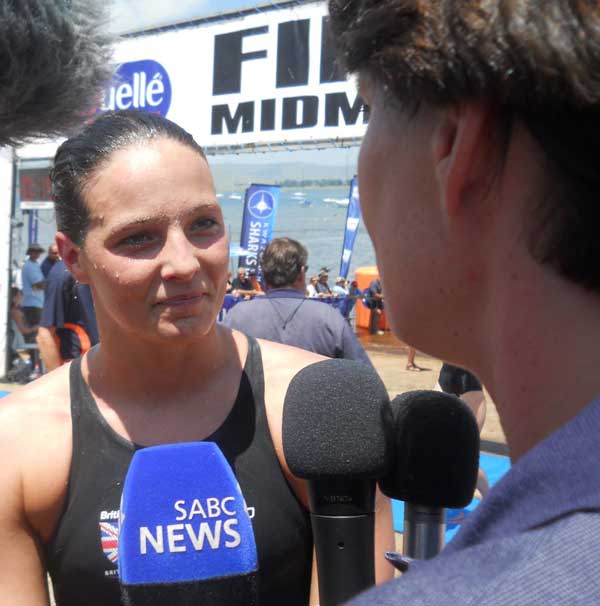
Keri-anne doing an interview with Penny Heyns after the 2011 Midmar Mile.
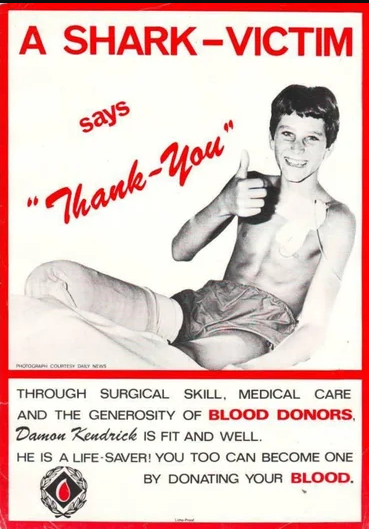
Damon Kendrick is a South African provincial diver, surf lifesaver, and Australian master's swimmer - despite losing a leg in a shark attack at age 14.
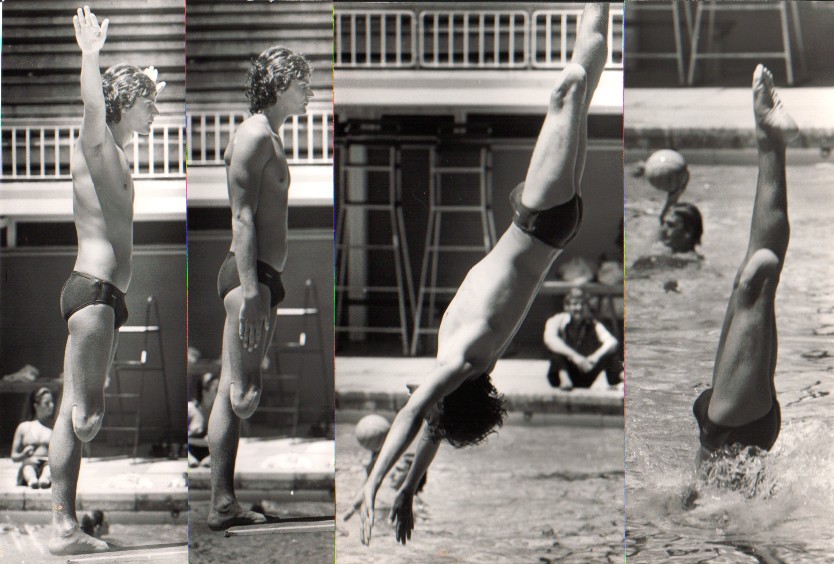
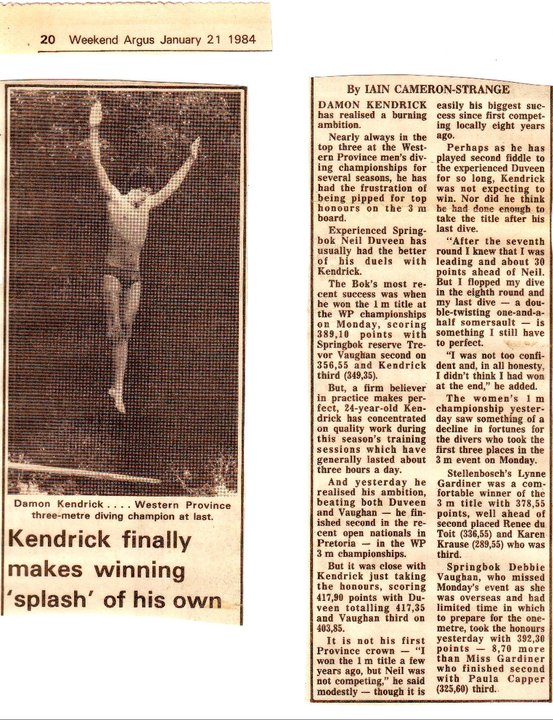
Damon Kendrick diving for Western Province at the South African Championships at Newlands in Cape town.
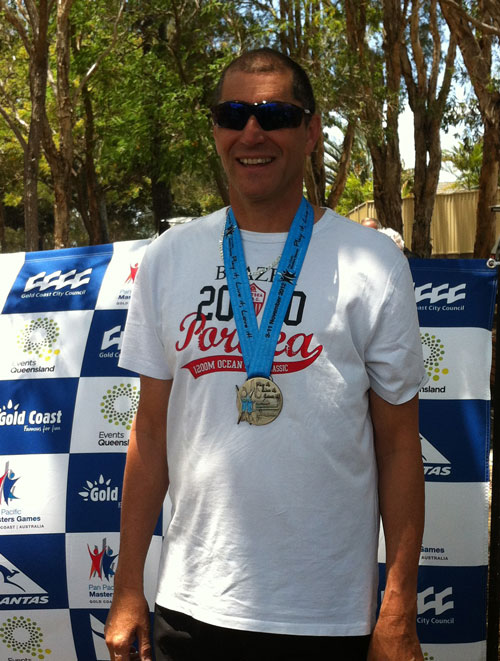
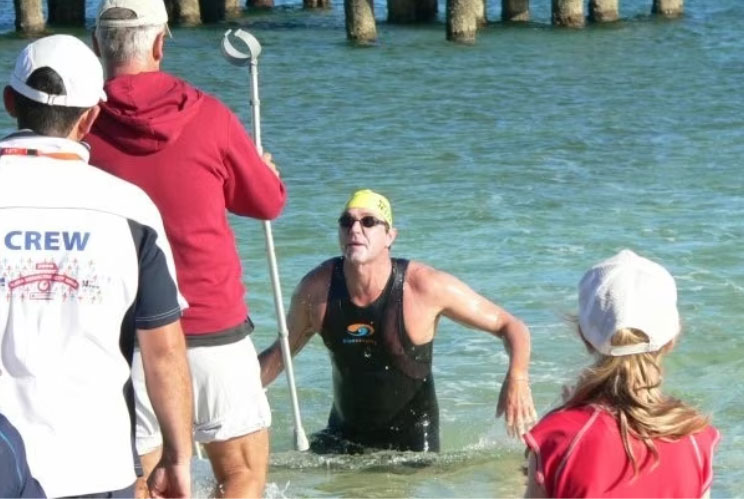
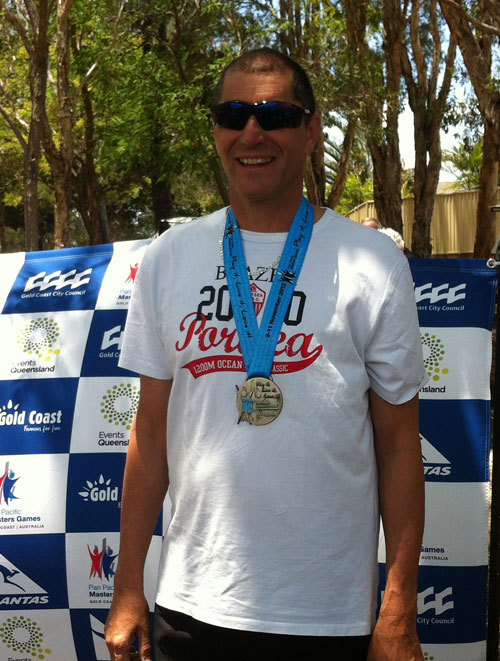
2010: The Zimbabwe-born 53-year-old, who now lives at Ermington in NSW, took the gold medal in the 5km open water swim (50-54 age group) today (Sunday) at the Pan Pacific Masters Games at Lake Hugh Muntz on the Gold Coast.
Won 2 gold medals, 2 silver medals, 1 bronze medal at the 2010 Pan Pacific Masters Games vs. able-bodied competitors
Won 4 gold medals and a silver medal at the 2009 World Masters Games
Won 5 gold medals at the 2005 World Masters Games
Compete in springboard diving
Is a flying trapeze artist
Completed the 105 km Argus Cycle Tour
Won the overall title at the 2011 20 km Geo Bay Swim in Western Australia
Damon’s 50th Sharkversary - 10th february 2024
On 26 February 2011, Damon swam the Rottnest Channel Swim, solo. He finished in six hours, fifty minutes.
Born in Zimbabwe to a mother who coached swimming, Kendrick says he “could basically swim before [he] could walk.” After moving to Durban, South Africa, when he was young, his family became involved in the city’slifeguard club. As part of his training, Kendrick learned to treat shark-bite victims. But even after an attack occurred at his local beach when he was 14, he didn’t worry about being bitten himself. When an anxious girl approached his lifeguard chair after the attack to ask if the water was safe for swimming, he responded: “It’s a once-in-a-lifetime occurrence. It’s never going to happen again.”
“The thought of being eaten while still alive was the hardest thing to understand,” he says. “Once you realize you’re part of the food chain—not sitting on top of it—it’s really difficult.”
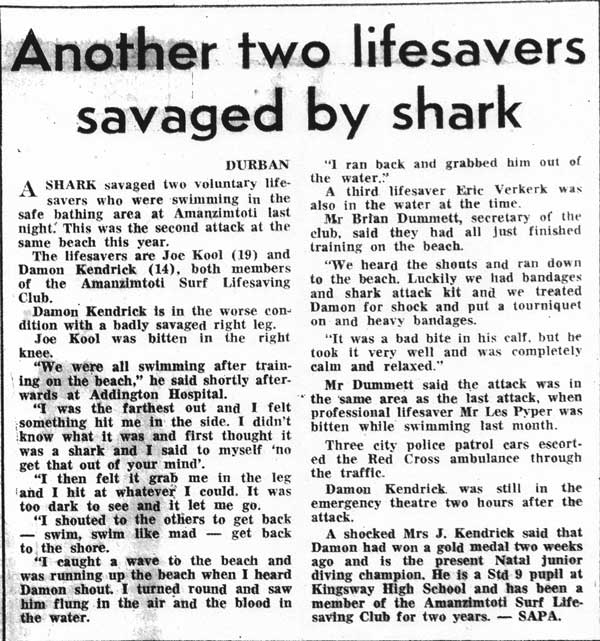
Three weeks later, Kendrick was swimming with other trainees when a shark attacked one of the boys in the group. Kendrick swam furiously toward shore. He was about to set his feet down, just yards from the sand, in water that was less than waist deep, when he felt himself pulled backwards and underwater. Experts would later say that likely a bull shark had clamped down on his calf, shaking him vigorously. The shark ultimately released him, but the bite was severe enough that doctors were forced to amputate his right leg below the knee. (The other boy’s injuries required only stitches.)
Damon Kendrick, about 36 hours after his attack.
After recovery, Kendrick quickly got back into competitive diving, a sport at which he’d excelled before the attack. Even with just one foot to push off of, he racked up multiple national championships. Later he threw himself into equestrian sports, dominating those, too. Eventually, he fell in love with open-water swimming and moved to Australia, where he frequently competed.
As he glided through the water during races, he’d often think of sharks. Recalling what a former swim-competition rival once called him, he created a mantra to repeat whenever he felt afraid: “I am a dolphin. I am a dolphin. I am a dolphin.” Dolphins are known not only for their speed and grace but also for their ability to defend themselves against sharks.
A few years ago, Kendrick had an urge to connect with other shark-attack survivors; after decades of healing, he thought he might be helpful. He joined the Bite Club Facebook group, and soon after, Pearson rode his motorbike to where Kendrick was living. The pair “got on like a house on fire,” says Kendrick. Like Pearson, he also began making hospital calls on new attack survivors in Australia. When survivors had to undergo amputations, Kendrick would regale them with stories of his athletic triumphs as a uniped, telling them, “You’re no less of a person.” Mostly, though, he assured them that they were not alone.
Damon and his Mom three days after the shark attack.
Shark attack victim jumps straight in the deep end
A shark attack at just 14 years of age that left him an amputee and put a halt to his teen surf-lifesaving dreams didn't stop Damon Kendrick from facing his fears and getting back in the water.
In fact, it was just a matter of months before he was swimming again, competing in springboard diving for more than nine years in his native South Africa.
And now, 36 years later, the WAtoday Rottnest Channel Swim may just be the ultimate test.
Damon Kendrick swims at least five kilometres, four to five days a week.
Nearly 20km of open seas can play tricks on a person's mind, and according to Damon, the mental side of the race is much harder to overcome than any physical barriers he may face.
"I love the water and the sea, and I have always swum competitively," he said.
"But I have never been back to that same beach where I was attacked."
It was the summer of 1974, and Damon was one of dozens of lifesavers on a beach near Durban, preparing for their championship competition.
"We were about 25m from the shore, all of sudden this guy just said 'Swim for shore, swim for shore'," he said.
"What I didn't know was that the shark had bumped him, and sharks tend to bump you and then circle around and come back in to bite.
"I didn't know that it had bumped him, and then come back and lacerated his knee and shin and that he was trailing blood through the water.
"I was swimming to shore just behind him, swimming through the blood.
"About three metres from shore, in 1m-deep water, I was just about to put my feet on the ground and start running."
It was then that the shark grabbed him by the leg, shaking him. His leg was so badly ravaged it needed to be amputated below the knee.
Luckily, Damon has a sense of humour, and said despite having a great 'scary story' at his disposal ahead of the WAtoday Rottnest Channel Swim, said he won't be using it to psych-out his opponents.
"On a long swim like that, your mind plays tricks on you, and it's more of a mental challenge," he said.
"It's stopping the negative chatter that goes on in your head."
Damon is confident that his training regime, swimming at least 5km four to five days a week, will be more than enough preparation for the 19.7km haul on the weekend.
"I have no doubt that I'll finish," he said.
"Ideally I would like to finish in under six hours, that would be great.
"A lot of it obviously depends on the conditions on the day."
Now in its 21st year, the WAtoday Rottnest Channel Swim is being held on Saturday, February 26.
Thousands of swimmers will depart from Cottesloe Beach at 5.45am, making their way 19.7km to the finish line at Thomsons Bay on Rottnest Island.
Shark Attack report
ACTIVITY:
Swimming
CASE:
GSAF 1974.02.13.b
SA-232
DATE:
Wednesday February 13, 1974
LOCATION:
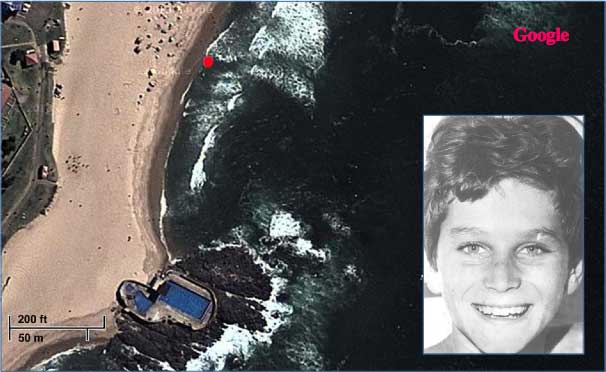
The incident took place in the Indian Ocean at Inyoni Rocks, Amanzimtoti, 26 kilometres southwest of Durban, Natal, South Africa.
30°03'S, 30°53,4'E
_________________________
NAME:
Damon Kendrick
DESCRIPTION:
The swimmer, a 14-year-old male, was 1,68 metres tall, weighed 42,7 kilograms and was clad in a red-orange speedo. He was well-tanned, wore no jewelry and had no injuries before the accident. Kendrick was the current Natal Junior Diving Champion.
BACKGROUND
WEATHER:
The weather was hot; temperature ranged from 24° to 27,7°C. The sky was cloudless and during the morning there was a light southwesterly breeze. Shortly after noon the wind changed to south- southwesterly, finally dropping completely at 19h00.
MOON PHASE:
Third Quarter, February 14, 1974
SEA CONDITIONS:
For some weeks prior to the incident, Natal had been experiencing heavy rains in the interior. As a result most rivers were in flood and emptying into the sea.
The flood conditions caused a marked water turbidity and deposited large quantities of plant debris and animal remains in the sea. Three metres from shore there was a wide channel where waves were reforming and breaking on to the beach. Water visibility in the surf zone was zero, and was only 1,2 metres beyond the backline. The sea temperature was 24ºC and high tide occurred at 17h46.
Large waves 1,2 metres in height were breaking on a sandbank about 175 metres from the beach. The waves rolled across the sandbank and reformed in a channel between the sandbank and the beach before breaking on the shore. The shorebreak had eroded a steeply shelving bank at the water's edge and created a close inshore channel, the incident took place seaward of this channel. A rip current flowed out to sea adjacent to Inyoni Rocks.
CONDITION OF THE SHARK NETS:
On February 6, 1974 surf conditions deteriorated making launching of ski-boats impossible. Large surf and rough seas persisted until the day after the attack. The nets had not been serviced for seven days and bathing was banned.
Inspection of the shark nets immediately after the attack revealed that five of the nine nets were severely bunched.
DISTANCE FROM SHORE:
The accident took place five metres from shore in the bathing area on the northern side of Inyoni Rocks.
DEPTH:
One to 1,5 metres
TIME: 19h01
NARRATIVE:
An official life-savingclub training period for the voluntary life-savers of the Amanzimtoti Surf Life-saving Club was held from 17h00 to 19h00. Five life-savers had entered the sea about 18h50 and body-surfed a few waves before returning to shore. Damon
Kendrick, Joe Kool and Eric Verkerk ran into the water at 18h55. They swam out about 15 metres and were body-surfing in the shorebreak as they swam northwards, parallel to the beach. Kendrick was 10 metres from shore, Kool was five metres seaward of him and Verkerk was seven metres south and slightly seaward of Kendrick. Kool felt something brush his side and moments later he felt a hard bump against his right knee. He shouted an alarm to his companions.
When Kendrick heard Kool's warning, he immediately began swimming towards shore and was in the shorebreak when he was bitten by the shark. He was about to stand when theshark seized his lower right leg. “I felt my whole body being shaken and I heard the shark growl,” said Kendrick. The shark shook his leg for about two seconds and then released
him. Kendrick was left in waist-deep water, the next wave washed him on to the beach where he pushed himself backwards away from the water's edge. At no time did anyone see the shark.
Kool and Verkerk reached the shore about ten metres south of Kendrick. Kool pulled Kendrick on to the beach and Verkerk found the club trainer and informed him of theincident.
INJURY:
Kendrick's right leg was bitten below the knee; a large amount of calf muscle was removed and the fibula, tendons and nerves were severed. The shark had made a single strike, biting his leg twice. The initial bite severed the fibula ten centimetres above the ankle and the serrated teeth of the shark scraped the tibia, cutting grooves and nicks in the bone.
This resulted in flaking of the bone which indicates that during the first bite the shark moved its head to the left as it bit in to the tibia; there was no flaking of the bone in the other direction. The second bite, a little higher up the leg towards the knee, removed the entire calf muscle and the fibula. The arc of the second bite measured 20,3 centimetres and the nicks in the tibia suggest that the shark removed the muscle from the leg with a movement of its head towards the right.
FIRST AID:
The club trainer, Stan Jooste, had just finished training the life-savers when Verkerk arrived and told him that Kendrick had been bitten by a shark. Jooste ran to where Kendrick was lying on his back on almost level ground with his head facing away from the water's edge. Jooste did not move him; he applied digital pressure to the femoral artery, gave instructions for the left leg to be raised and the injured leg to be placed on a towel. One of the life-savers, Schravesands, was told to call a doctor and alert the ambulance, hospital and Traffic Department. This was accomplished within six minutes of Jooste arriving at the scene of the incident.
The Shark Attack pack, containing a first-aid trauma kit and blood plasma, was brought from the clubhouse. Miles Kendrick made a tourniquet from a triangular bandage and tied it above the right knee. Digital pressure on the femoral artery was released and the time noted so that the tourniquet could be loosened every 15 minutes. Sterilized gauze bandages were placed over the wound which was then packed with cotton wool pads. The lower right leg was tightly bound with a 10-centimetre crepe bandage which acted as a pressure bandage.
Dr. Dyer arrived at the beach and was informed of the severity of the wound. Kendrick's pulse was 90 beats per minute and weak but regular. His blood pressure was 70/40. Dr Dyer gave him an injection of 75 ml pentathol.
The ambulance arrived and Dr. Dyer gave orders to move Kendrick to the ambulance. Blood plasma had been reconstituted by the life-savers M. Sadler and B. Dummett while waiting for the doctor and it was administered in the ambulance. The pulse was again measured and found to be 79 beats per minute, strong and of full volume. Blood pressure was 100/70.
To prevent further trauma to Kendrick, the ambulance driver was instructed to drive slowly to Addington Hospital in Durban. Traffic Police escorted the ambulance and stopped traffic at all intersections en route, allowing the ambulance to reach the hospital without stopping.
From the time of the incident to the arrival at the hospital 62 minutes elapsed:
19h00 - incident
19h20 - bleeding stopped and wound dressed
19h32 - arrival of Dr Dyer and patient placed in ambulance
19h39 - set up plasma drip intravenously 20h02 - arrival at hospital.
Throughout the whole procedure, the patient was treated with gentleness and constantly reassured.
TREATMENT:
On arrival at the hospital Kendrick's pulse rate had increased to 120 beats per minute. The bandages were removed and he was taken to Casualty where the injured and heavily sand-contaminated leg was examined by three specialist surgeons. They reached a unanimous decision that the leg could not be saved because of the removal of gross muscle tissue with the severance of the major nerves and tendons. Kendrick's right leg was surgically amputated below the knee.
SPECIES INVOLVED:
Three serrated tooth fragments were recovered from shallow nicks in the tibia by NSB Research Officer Tim Wallett on February 14, 1974. “The tooth chips, bearing distinct serrations, are very small and it is difficult to determine what species of shark was responsible for the attack,” noted Wallett. “Microscopic examination of the tooth fragments indicates that the serrations are similar to those found in a number of Carcharhinus teeth.” (No species identification was made and the tooth fragments have since disappeared.) “NSB meshing records confirm that the dusky shark is the most common shark species caught in the inshore region and the serrations on the tooth fragments also resemble those of dusky shark teeth. Similarities also exist between the serrations present on Zambesi and Java shark teeth and these two species are likely candidates due to their past reputation.”
“Measurements of the wounds indicated that the jaws of the shark were 190 millimetres wide. The arc of the jaw, measured from the injuries sustained by Kendrick, indicates that the length of the incidenter was approximately 1,9 metres. Regrettably, there was not sufficient evidence to conclude which particular species was responsible for this incident.”
COMMENT:
Less than a year after the incident, Kendrick swam the Midmar Mile at Midmar Dam near Pietermaritzburg. For the next nine years, he represented the Western Province as a springboard diver. In 1986 he joined Masters of the Sky troupe as a trapeze artist.
SOURCES:
Interviews with Damon Kendrick; Stan Jooste; Graeme Charter, Tim Wallett & Beulah Davis, Natal Sharks Board
CASE INVESTIGATOR:
Marie Levine, Global
Shark Accident File
Shark attack victim blitzes the competition in the Geo Bay Swim
DAMON Kendrick may have lost a leg to a shark attack when he was 14, but he is not one to shirk an ocean swimming challenge.
So when a young competitor pointed at his leg before the
Geo Bay Swim on Sunday, and said “You better not beat me” it only made the Perth-based swimmer even more determined, even though another large shark had been spotted in the area around the time of the event.
“Right I thought – Game on,” he said. “All the way I imagined him 100m behind me and I had to stay ahead.
“I beat him by well over an hour and didn’t I enjoy rubbing his face in it.”
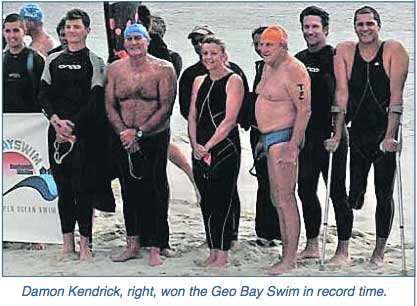
Not only did Damon beat that young bloke, but he also smashed the course record for the 20km swim by around 20 minutes as he was the first individual competitor to emerge from the water.
His time of four hours, 44 minutes, and 54 seconds was well ahead of second-placed Steve Wilson who came home in 5:19:32.
Damon lost his leg in South Africa while training to be a surf lifesaver when he was attacked by a shark just metres from the shore. "I was in the water, not even three feet deep when it grabbed me, shook me like mad, and then dragged me under," he said in a newspaper report in 2009. Damon
said he knew instantly what it was and thought he was going to die. But, he managed to survive the attack although his leg was so badly ravaged that it needed to be amputated. But, despite the encounter it hasn’t put him off the ocean and has since become a champion athlete. Earlier this year he became the first amputee to complete the Rottnest Channel Swim, he won two gold, two silver and a bronze medal in last year’s Pan Pacific Games, competing against able-bodied competitors and won numerous gold medals at the last two World Masters Games. He said the finish to the Geo Bay swim was difficult, despite the record time. “The tailwind helped fo the first 15 kms and then it worked against us. The final leg was brutal. I was 35 minutes ahead ofthe second solo and an hour ahead of the third.
Organisers of the Geo Bay Swim, from Quindalup to Busselton, said a shark sighting in the area on the weekend didn’t affect it – even with a team named Shark Bait among those competing.
BUSSELTON, AUSTRALIA. If Damon Kendrick was a word, he would be all over the dictionary: courageous, positive, inspirational, unbelievable.
Damon lost his leg as a result of a shark encounter in South Africa at the age of 14, but his fast-paced life and exploits have not taken a hit. He became the first amputee to complete the 19.7K Rottnest Channel Swim in Western Australia.
But the multi-talented athlete from Perth really stepped it up at the 20K Geo Bay Swim from Quindalup to Busselton this month.
Especially since a large shark had been spotted in the area. "Right, I thought – game on," in words that make sense in a pool or basketball courts, but are unbelievable from a man without his right foot. "All the way I imagined him 100 meters behind me and I had to stay ahead. I beat him by well over an hour and didn’t I enjoy rubbing his face in it."
Damon won and set a new course record in 4 hours, 44 minutes and 54 seconds, ahead of second place Steve Wilson in 5:19:32.
Damon recalled when he lost his leg, thinking he was going to die. "I was in water, not even three feet deep when it grabbed me, shook me like mad, and then dragged me under. I remember drawing a breath and thinking it was the last breath I was going to take.." After his amputation, Damon thought, "I could cry, but what’s the point of that, it’s not going to bring my leg back. So I just thought I would do the best I can."
And his best is the best there is to offer.
The loss of a leg to a shark 39 years ago has done nothing to quell Damon Kendrick’s love of swimming and the ocean.
The Zimbabwe-born 53-year-old, who now lives at Ermington in NSW, took the gold medal in the 5km open water swim (50-54 age group) today (Sunday) at the Pan Pacific Masters Games at Lake Hugh Muntz on the Gold Coast.
“I grew up in South Africa and I’ve lived here in Australia for the past 18 years,” said Kendrick.
“I was bitten by a shark when I was 14. It (missing the leg) doesn’t really affect me.”
Kendrick’s win on Sunday was as personally satisfying as it was hard fought. He beat home swimmers much younger and registered the fourth fastest time across all age categories.
“The wind was blowing hard and it made for some tough swimming at some parts of the lake,” said Kendrick.
“There was a guy just ahead of me (and) we swam around together for three laps and he pulled ahead of me just at the end.
“Most of the lake isn’t too bad, but down at the bottom corner it seems to get a huge chop.
“It‘s like the ocean and there is a surface current going in the opposite direction and you really have to fight your way back.
“It seemed to get worse each time, so I don’t know whether it was me getting tired or it was actually getting worse.”
The win rounded off a spectacular week of success that also saw him take the gold medal in the 400m freestyle and two silvers and a bronze in the swimming competition at the Southport Olympic Pool.
At the 2010 Pan Pacific Masters Games he delivered identical results, winning two gold, two silver and a bronze medal.
Kendrick said, despite its all-too-obvious perils, he has had a life-long love affair with the water.
“I was born into a swimming family. My mother was a swimming coach so I could swim before I could walk.
“At one stage I did gymnastics for a few years and then springboard diving and when the joints got sore I went back to swimming.
“I’ve since swam at the World Masters Games in Melbourne, Edmonton and Sydney.
“Edmonton and Sydney had a ‘swimmers with a disability’ category which was nice because I could pick up some more medals there.
“It was especially amazing going to Edmonton and being in a foreign country competing and meeting people from all over the world.”
Kendrick said that, unlike many things in life, age can bring distinct benefits to Masters participants.
“What I like is that most people fear getting old, but when you compete in Masters sport you look forward to getting older because you have an age advantage,” he said.
When asked about the possibility of returning in 2014 to defend his Pan Pacific Masters Games titles he responded immediately, “Oh yes, absolutely.”
Everyday People – Damon Kendrick
Everyone who competes in endurance events is usually mentally tough and has battled through many obstacles. Damon Kendrick has overcome more hurdles than many, after losing half his leg during a shark attack in his teens. However, this has not prevented him from becoming a champion master’s swimmer, both in the pool and open water. Below he talks to us about his ultimate achievement, swimming a Rottnest Channel Swim solo crossing in 2011.
Name: Damon Kendrick
Age: 52
Resides: East Victoria Park, Western Australia
Tell us about swimming the Rottnest Channel (20km) solo in 2011.
Doing the Rottnest swim was not really on my radar for a long time. The first time I heard about the Rottnest swim was when I arrived to live in Perth 8 years ago. I thought that anyone who attempted the swim were crazy or had a death wish or both. Then a couple of people in the squad I train with did the swim. One of them was my very good friend Lyndal. She not only did it once, but twice, and she is terrifyingly NORMAL! That got me thinking that if she could do it, so could I. One day I was training at a local 50m pool when in walked my friend Paul Blackbeard. He used to be the captain of the South Africa swim squad, and at the peak of his swimming career, he was regarded in South Africa very much as we regard Thorpie in Australia. He said that he was doing the Rottnest swim and that it would be good for me to do that too. I am always up for a challenge and it didn’t take very much convincing that I should do it. After all, I had done some open water swims recently and I wasn’t as scared as I thought I would be.
I started to read up about the Rottnest swim and its history and I found a blog of Open Water swimming on the net. I also talked to a few people who had done the swim, particularly Lyndal and started to think about strategies and feeding regimes etc. My coach Stuart agreed to be my paddler and I started the task of trying to find a boat.
A requirement of the organisers, are that if you are a first-time swimmer, or have not done the swim in the past 5 years, then you have to qualify by swimming a 10km time trial in under 4 hours 15 minutes. I chose a 10km swim held at the Champion Lakes rowing facility in Perth for several reasons, no currents, no waves and no stinging or biting creatures. The swim was 4 laps of a 2.5 KM loop. We were not allowed paddlers and any food or drink had to be on a pontoon. I completed the swim in 2 hours 37 minutes 49 seconds, slightly disappointed that I did not manage to finish it in under 2 hours 30 minutes. Nevertheless, I came second in my age-group behind Paul who did it in 2:25:16.
On the morning of the swim, I was up before dawn preparing for the longest swim of my life. I usually get really nervous before any event and my partner knows to keep out of my way, do anything I ask and agree with everything I say. Sorted! This morning was different. I had no nerves at all. As we were driving I even commented that I still could not believe that I was about to attempt to swim the Rottnest Channel. It was a feeling of unreality, like I was watching a movie about my life, but this was fiction. I had not yet done what the movie was about. We arrived at Cottesloe beach in the dark and there were people scurrying all over the place and there were lights everywhere and registration tents. Registration opened at 5am and we got there at 4:40 am. I didn’t really know what to do with myself. I was in the first wave of starters which set off at 5:45am. The horn went off all too soon and I had no time to be nervous. I consciously tried not to sprint too hard at the start of the race as I did not want to blow out too early.
I had arranged for my paddler Stu to meet me just after the 1 km mark on the northern side of Cottesloe Beach. The rules of the race stated that your paddler had to have picked you up and your support boat needed to be accompanying you before you swam past the safety vessel anchored 1.5km off shore. I could see all around me that most of the swimmers had met their paddlers. That same awful feeling of being abandoned by my mother at school on the first day welled up inside me. I stopped, popped my head up and yelled STUART! “Here I am” he said. I hadn’t even seen that he had been following me for the past 300m. Serious swimming ensued. As the sun came up there were amazingly beautiful patterns of light dancing in the water. People had told me that apart from the shipping channel you could see the bottom the whole way across. It was true. My first water stop was at about the 3 km mark. After that I relied on Stu to stop me and give me water, gel, bananas and baby food. I felt really strong for a long time. I thought that after having seen the bottom for so long that swimming across the shipping channel would worry me but it didn’t. From the 11 km mark I had intermittent bouts of nausea. By this time Stu needed a break and Lyndal took over the paddling for a while. She said that it might be best for me not to fight it but to let it all go. I couldn’t do that, but at the 15 km mark I had no choice and I spewed my guts out.
I reached the 15 km mark in 3 hours and 45 minutes. Despite the vomiting, I still felt strong. Then a current came and dragged us southward. When I stopped next to the kayak for a drink, by the time I threw my water bottle back to my support crew I was 10 m away from where I had stopped. I now not only had to swim extra distance, I also had to swim against the current which meant my overall pace slowed, and I had to swim northwards to get back on track.
The last 5 km was not easy. I was battling fatigued shoulders, low nutrition, and a current. Never once did I think of giving up though. It simply did not enter my head as an option. At one point I felt I was getting nowhere as I could not see Phillip Rock, which indicated the 18 km mark of the race and shouted to Stu “Where is that *&#@ing rock?” He calmly pointed to it about 400m away. Then he told me I had to kick now. I felt a surge of energy knowing I was within reach but not daring to get excited about the finish. He pointed out the finish to me, several times. The trouble is that with goggles on and being at water level does not give one a good perspective for line of sight. The paddler is invaluable to a Rotto swimmer. There was a line buoys which started at 400m from the finish line and that was where Stu had to leave me and paddle on the other side. Only now did I feel that I could push to the end. I saw the finish, the people watching and could hear the commentary. I got to the shallows where my partner was waiting for me with my crutches. Exhausted yet elated, I finished in 6 hours 50 minutes. It had taken me 3 hours and 5 minutes to swim the last 5 kms, almost the same time it took to swim the first 15 km. I had just become the first amputee to complete the Rottnest Channel swim solo.
How difficult was it getting back into ocean swims after losing half your leg in a shark attack as a teenager? What inspired you to do so?
Having lost my leg in a shark attack when I was 14 years old as a newly qualified lifesaver on active duty, I have a healthy respect for the sea. I had never been as deep in and as far from the shore as when I did the Busselton Ironman swim. The jetty gave me some comfort as I felt that I could always get onto the jetty if something went wrong, or I was too paranoid. The day before the Busselton ironman I was really nervous and I had to go on a walk out to the end just to see what it was like and familiarise myself with the landmarks. When the race came, I was not any more nervous than I am at a pool event. It was just race nerves no more. I had no sense of paranoia which I thought I might have. The water was as flat as a swimming pool and crystal clear. It was really difficult to concentrate on swimming because of the myriads of different schools of fish. At one time I swam over the top of a whole school of small stingrays. It was simply magnificent. Somehow I felt at home in the water again.
Tell us about your comeback into open water swimming
I was doing swimming training with a triathlon squad, and one of the members had an injury which prevented him from running. I made the brilliant suggestion of why didn’t he get a team together for the Busselton Ironman and do the cycle. All he needed to do was find a swimmer and a runner. The very next session he asked me to swim. I thought about it for about 2 seconds and said yes. That year we came second out of 50 teams. The following year we won. I went on to do some half ironman team events as well and our teams always did very well.
I then competed in the Pan Pacific Masters Games in 2010 and I did 4 pool events and the 5 km open water swim at Lake Hugh Muntz, a fresh water lake on the Gold Coast. I came first in my age group and third overall and that gave me another boost.
You have a long history of achievements in masters swimming competitions. Tell us about some of your other results.
I come from a swimming family and gave up swimming first for gymnastics and then for diving. I dived at 9 consecutive South African National Championships from 1979 onwards. In 1980, I won the State championships for the first time, and in 1984 I came second in the National Open Championships. I only went back to swimming in my late 30’s in the Masters. In 2005, at the World Masters Games in Edmonton, Canada I won 5 gold medals swimming in the swimmers with a disability (SWAD) section. If I had been swimming in the able bodied section I would have had a 7th, 6th, 5th 4th and 2nd place. At the 2006 Pan Pacifica Masters Games I won 1 gold, 2 sliver and a bronze medal swimming against able-bodied swimmers. At the World Masters Games in 2009 in Sydney, I won 4 golds and 1 silver in the SWAD section. AT the 2010 Pan Pacific Masters Games I won 2 golds, 2 slivers and a bronze medal, again swimming against able bodied competitors. I currently hold the WA State masters record in 1500m in the 50-54 year age group.
What does a typical training week look like for you?
Out of competition season I swim three mornings a week from 5:30 am to 7:00 am. I usually swim between 4 and 5 km each session. In season, I boost the pool swimming to 4 times a week and add an open water swim once a week. That usually gives me about 22- 25 kms per week
You have overcome many obstacles in your life but have not let anything stand in the way of getting the most out of everything you do. What advice do you have for others on how to deal with setbacks or unfortunate events?
You cannot change the past, but you can change the future. Your attitude will make a huge difference to the way you experience the rest of your life. You cannot focus on what you don’t have, focus on what you do have and make the most of that!
So what’s next? Do you have any races/events/competitions on the horizon?
I have entered the Geo Swim in WA. That is a 20 km swim from Dunsborough to Busselton going around my favourite jetty again. Then I am heading off to Melbourne for the ‘Bloody Big Swim’ (yes, that it its official name!) swimming the 11.2 km form Frankston to Mornington
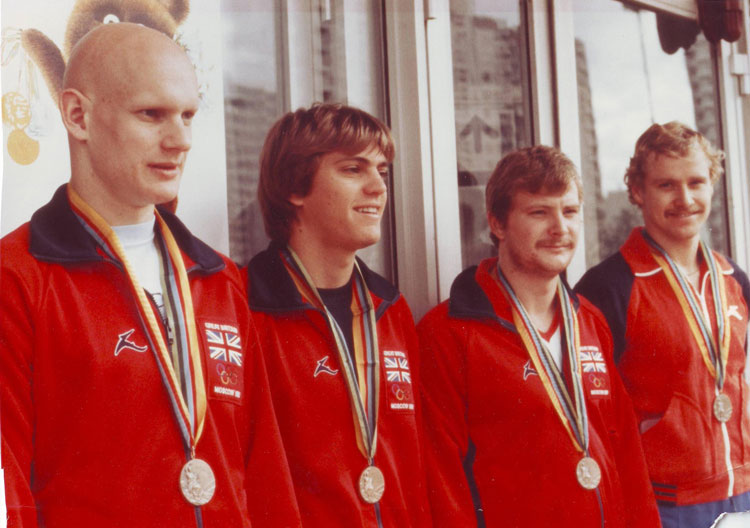
The GB men's 4 × 100 metre medley relay team - Duncan Goodhew, David Lowe, Gary Abraham and Martin Smith
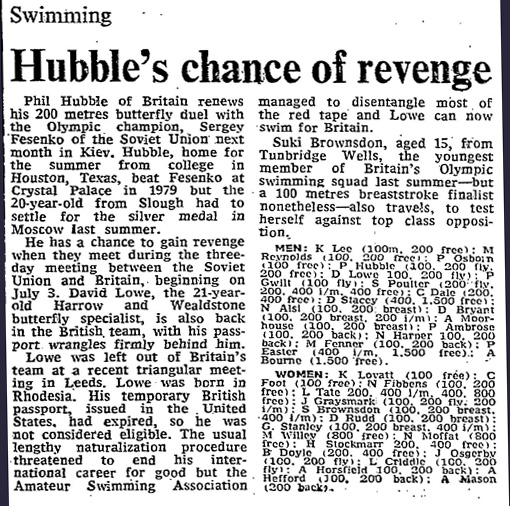
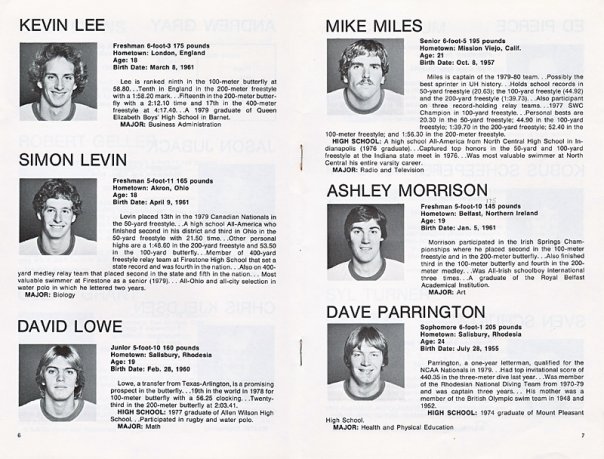
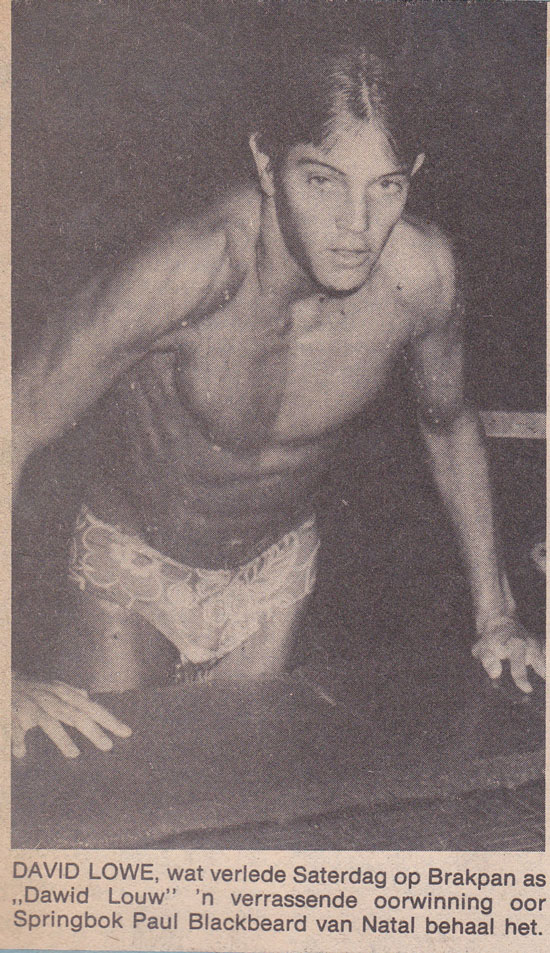
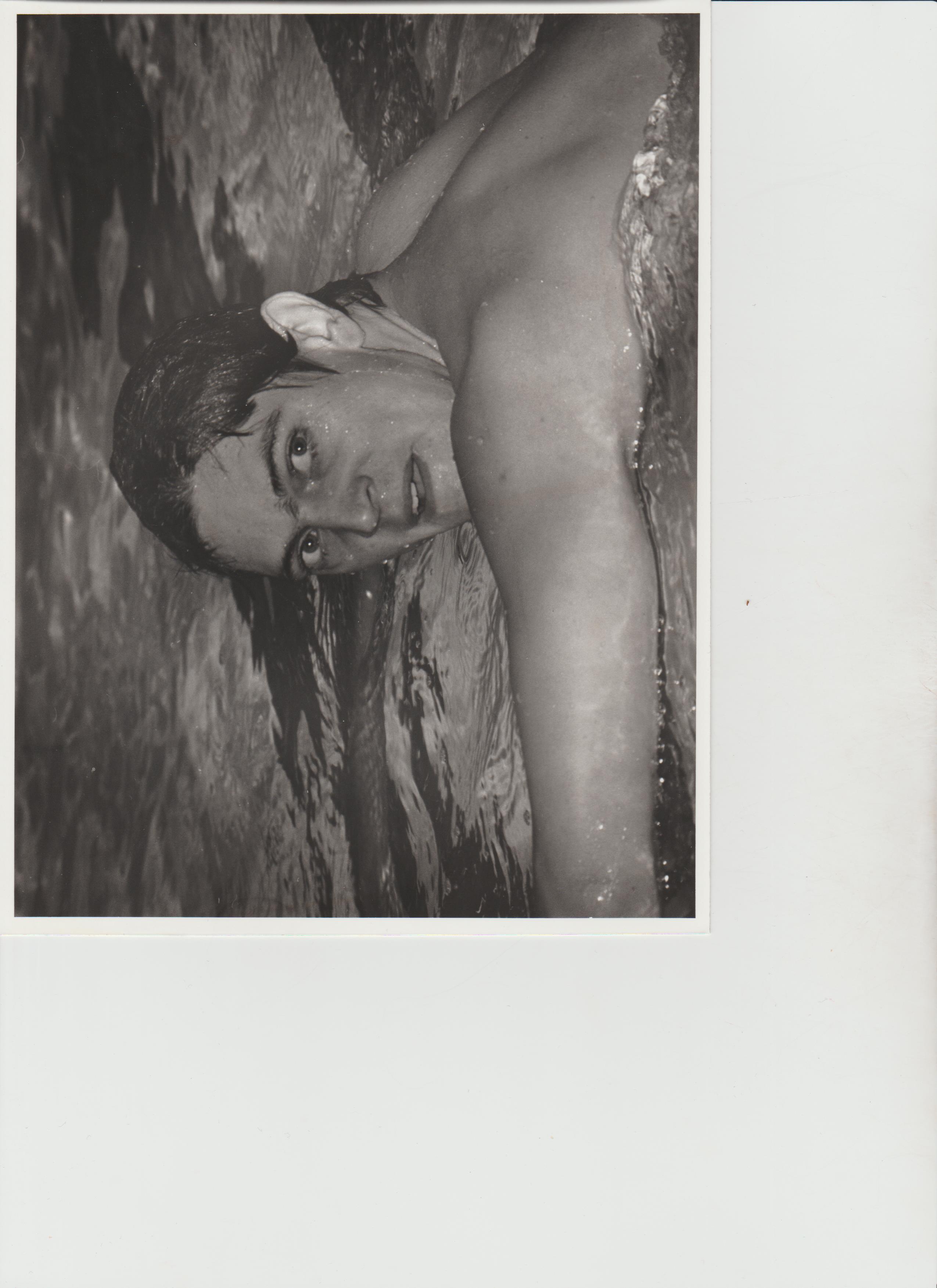
David Lowe was another successful ex-Rhodesian swimmer who won an Olympic medal - for another country. He was born in Bulawayo on the 28th of February 1960, coached by Sydney Gibbons, himself a South African butterfly champion in 1962, before moving to South Africa in 1976. At the 1977 South African Championships held at the Newlands Pool in Cape Town, David won three events - 100 and 200m butterfly, as well as the 200 IM. In the fly events, he broke the national records set by fellow Rhodesia John Keyter in 1969.
Dave took up a scholarship at the Southern Methodist University (SMU) in Texas in 1978, and transferred to the University of Houston in 1979. By 1980 he moved to the UK, where he soon became a regular on the British team. He won a bronze medal in the 4x100 medley relay at the 1980 Moscow Olympic Games.
His swimming focus then changed from butterfly to freestyle, and he became the first British man to break the 50-second barrier in the 100m Freestyle SC when he swam a time of 49.86 seconds at the 1983 National Short Course Championships in Gloucester. At his second Olympic Games in the 1984 Los Angeles Games, David finished third in the B final of the 100m freestyle.
In 1987 David returned to Cape Town for the Spur Robben Island Relay Race, held between Cape Town and Robben Island. With fellow Houston swimmer Kevin Lee, Kevin Murphy (the man who has done the most Channel crossings, and Annemie Landmeters - who was the first person to swim across False Bay. Their team finished in 4th place.
After retiring from swimming Dave has been working as a swimming coach in England.
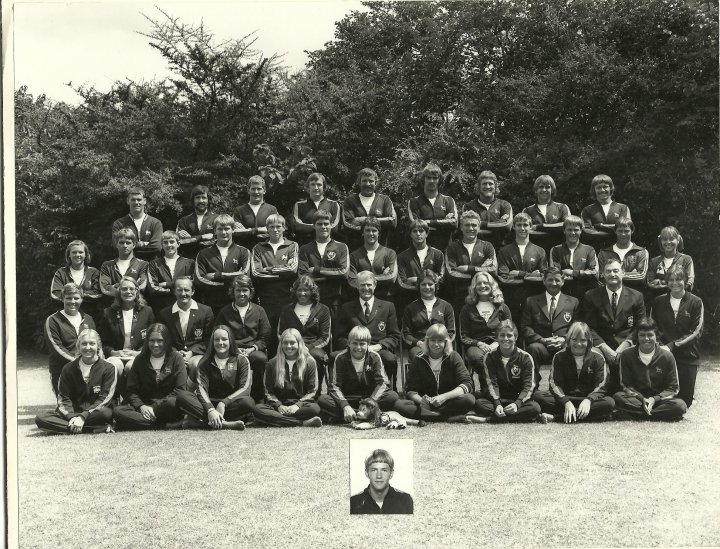
David Lowe in the 1977 Rhodesian national swimming team, in the middle row 6th from the right.
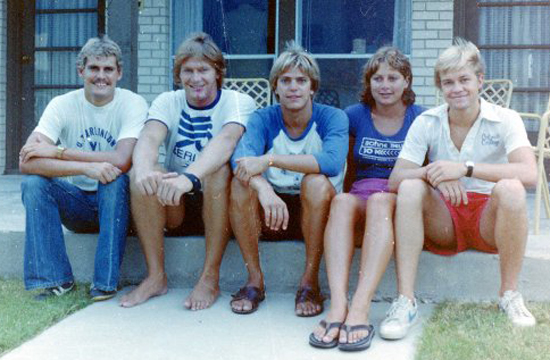
Rhodesian swimmers and divers in Dallas Texas in 1979. l to r. Guy Goosen, Dave Parrington, Dave Lowe, Debbie Hill, Kris Hammond (who dived for Rhodesia at the 1976 South African Championships in Durban, when he was an exchange student from the US attending Oriel).
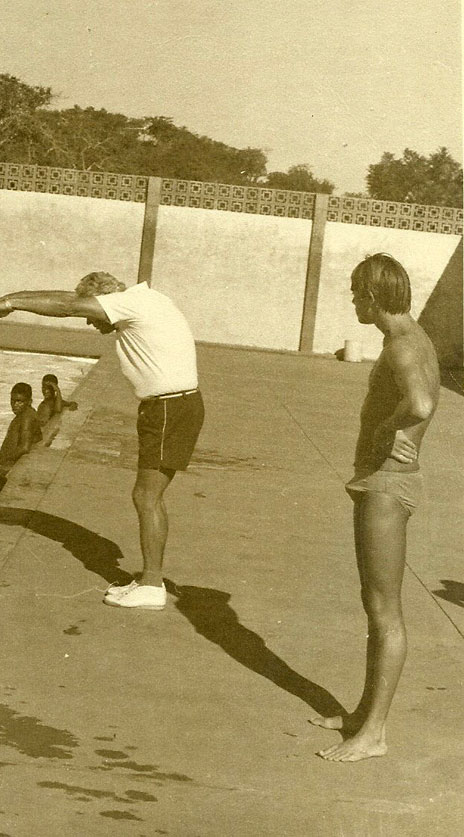
Dave Lowe with coach Frank Parrington, at a clinic in Rhodesia.
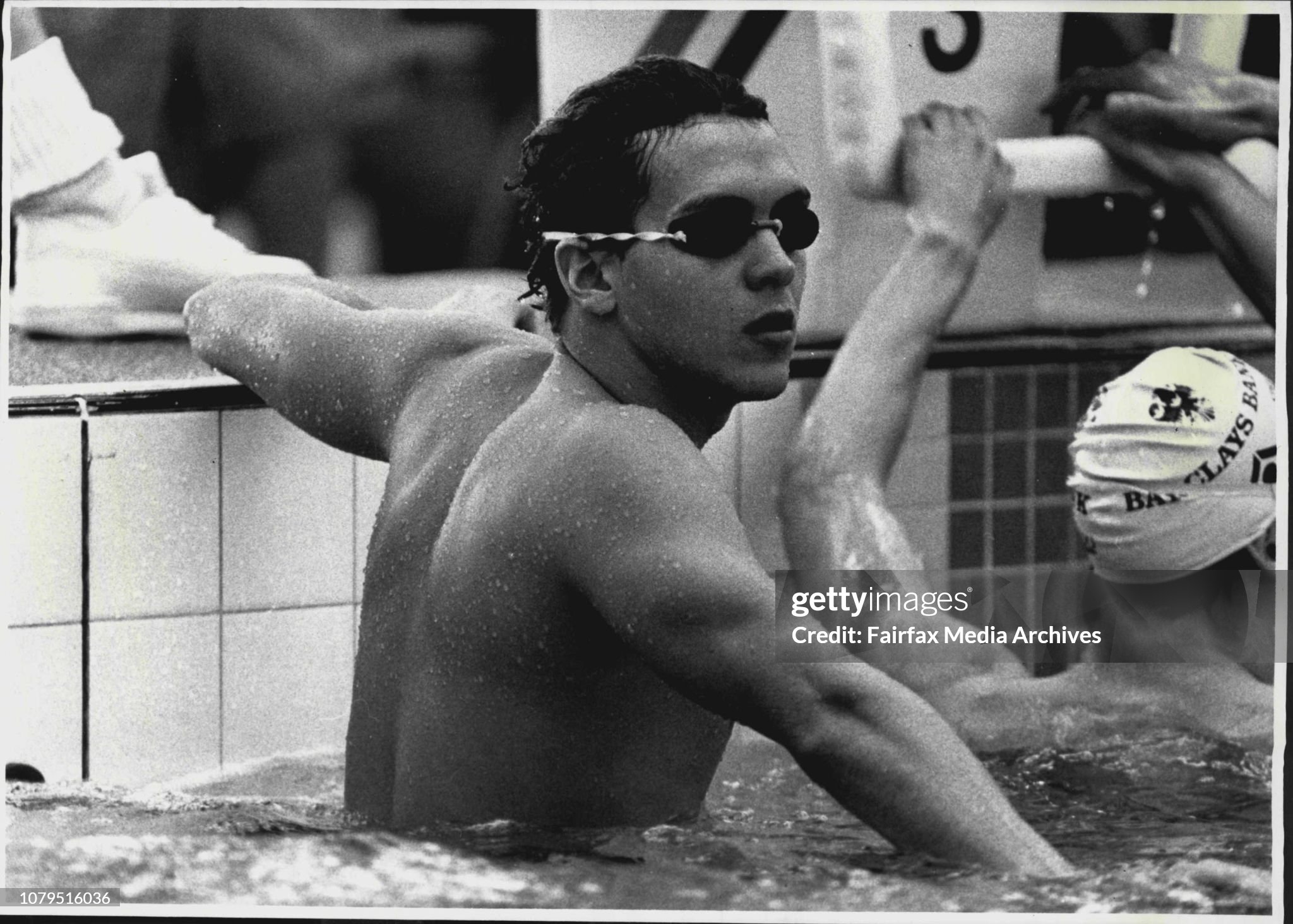
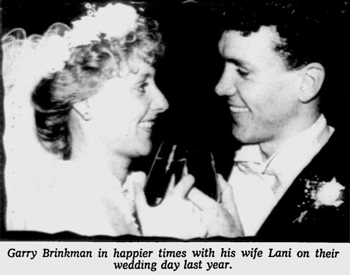
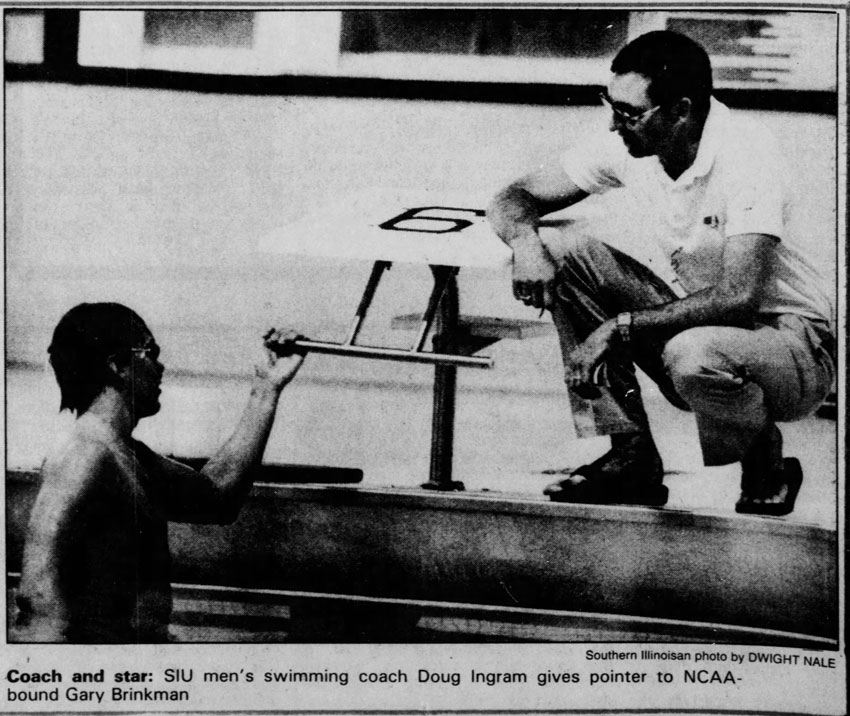
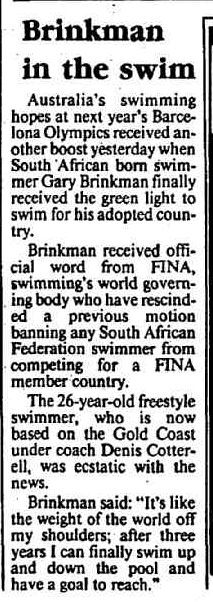
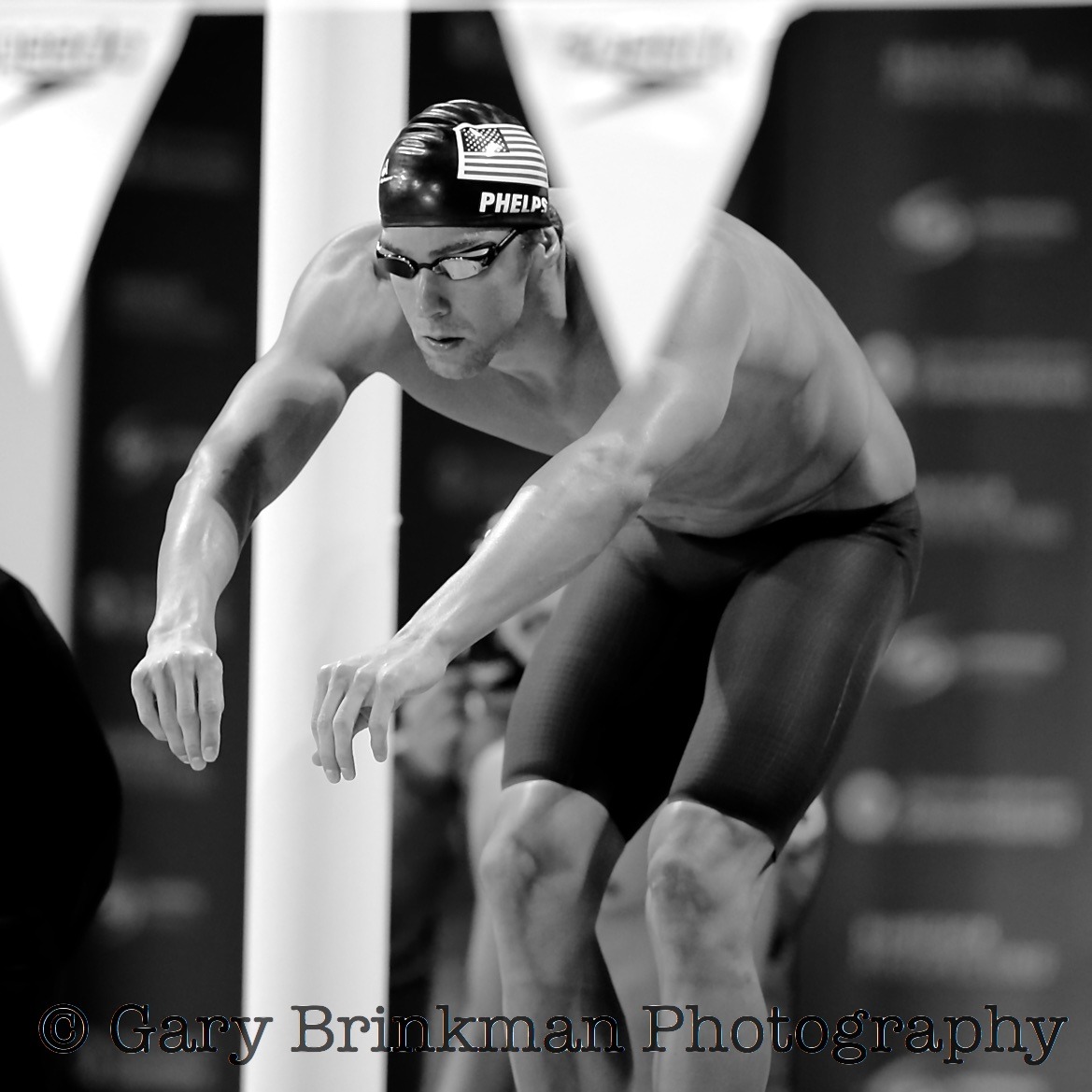
May 1988 - Olympic Swimming Trials At Warringah Aquatic Centre, Australia - Gary Brinkman preparing for training and hoping for an Aussie spot at Souel.
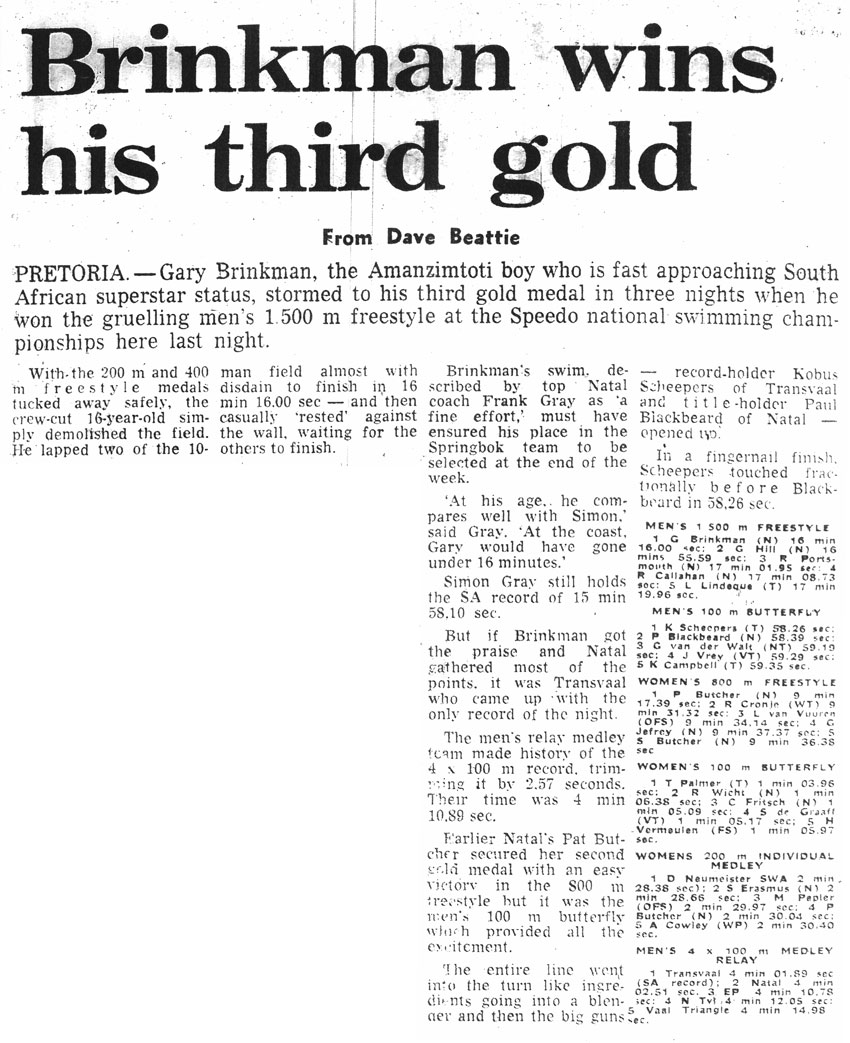
Like Penny Heyns, Gary hails from Amanzimtoti in Natal, where he swam at the Kingsway High School and competed for Amazimtoti Surf Lifesaving Club.
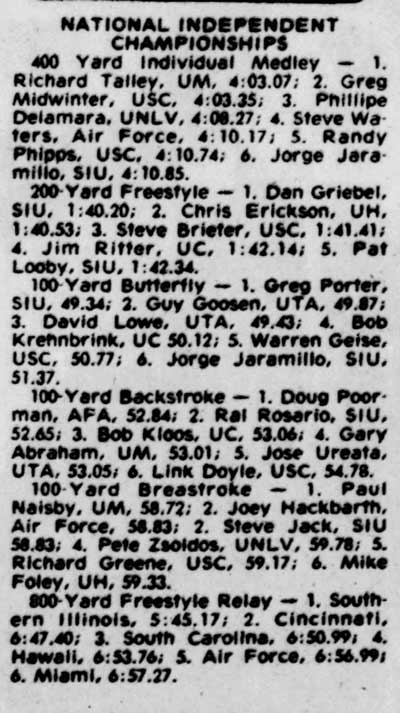
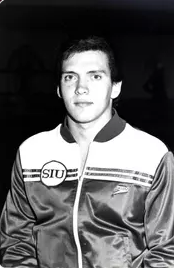
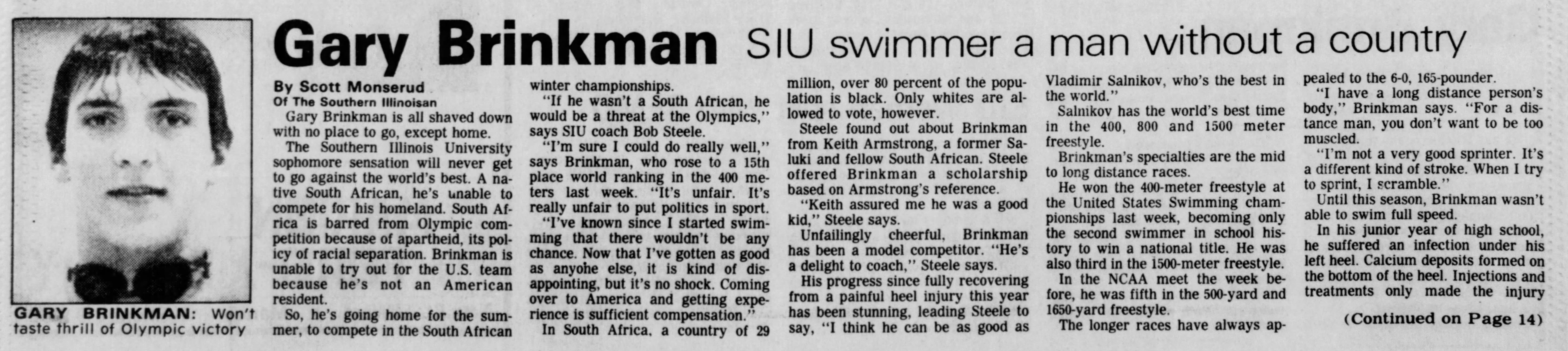
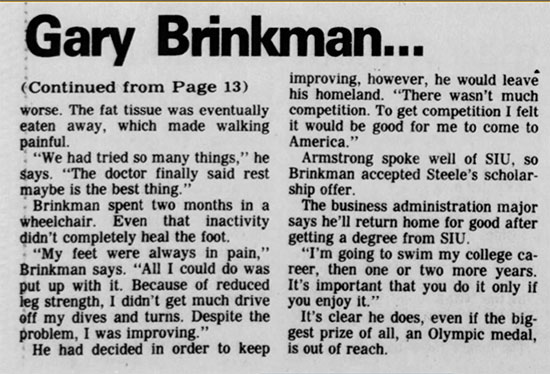
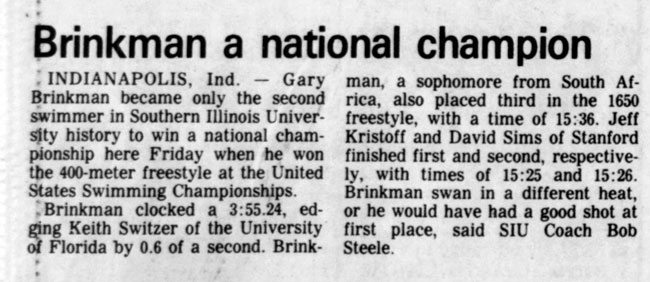
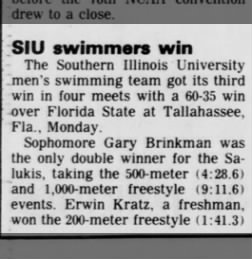
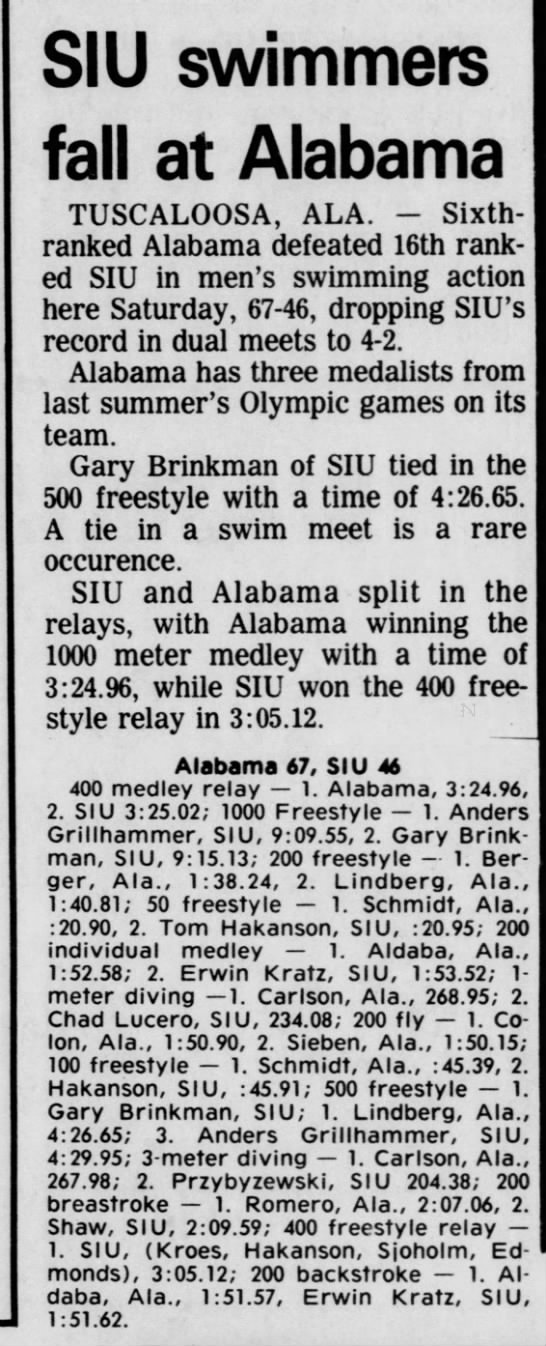
In 1981 and 1982 he won the Midmar Mile. At the South African swimming championships in 1982, Gary won three gold medals. In January 1983 Gary Brinkman took up a scholarship and joined fellow Springboks Erwin Kratz and Gerhard van der Walt to swim for the University of Southern Illinois, and by 1984 he had already won a US national swimming title. At the US nationals in August, he won the 400m freestyle in 3:55, 24., which was a significant improvement on his winning time at the South African Championships in Pretoria in 1982 was 4:10,79.
He also took third place in the 1500m freestyle in 15:36, considerably faster than the SA record held by Simon Gray at 15:58. Gray's record was only (officially) broken by Ryk Neethling at the SA Championships in 1994 - in 15:56,66.
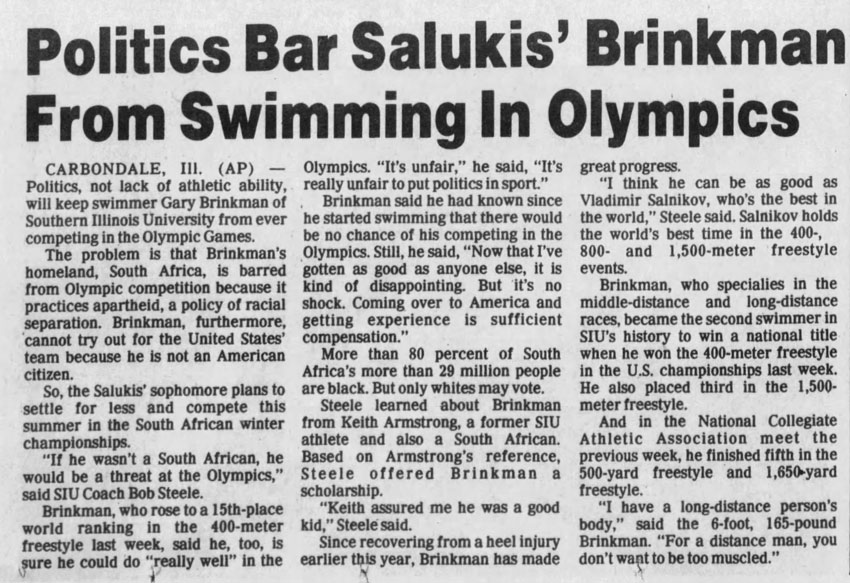
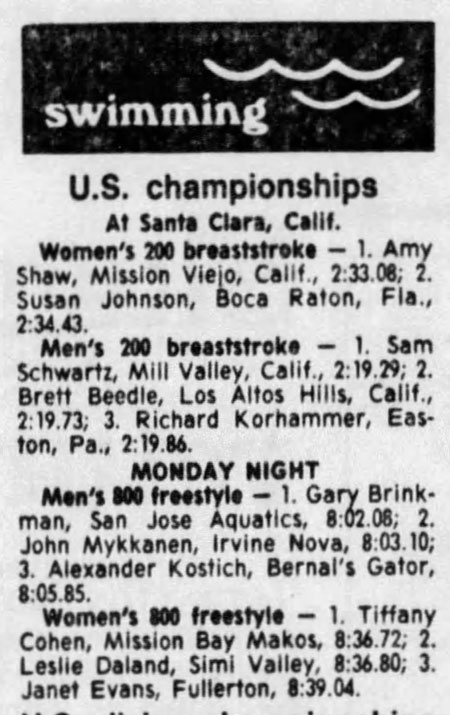
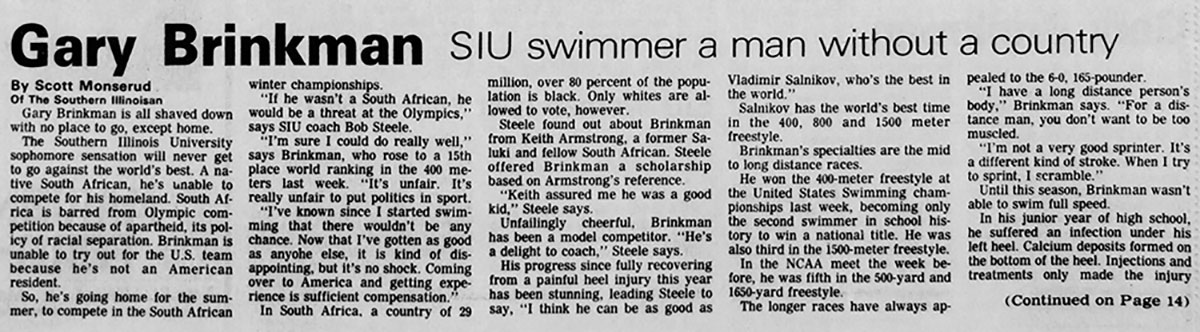
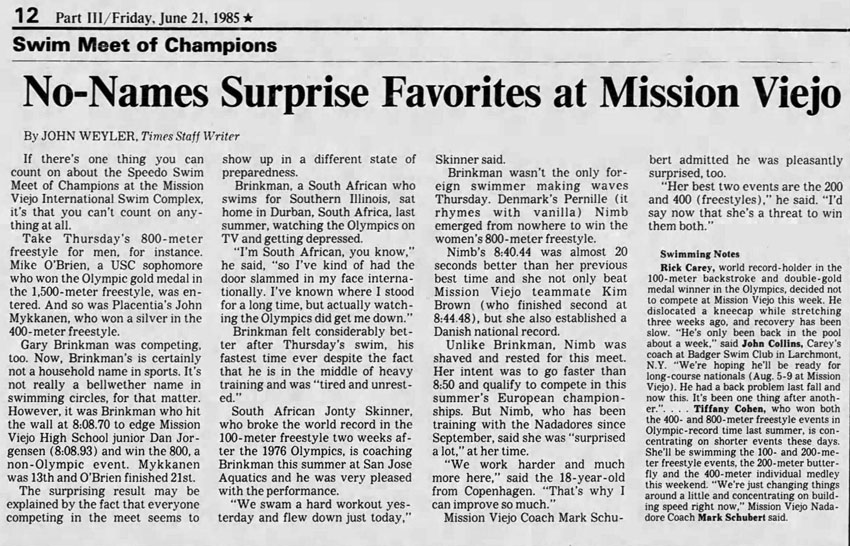
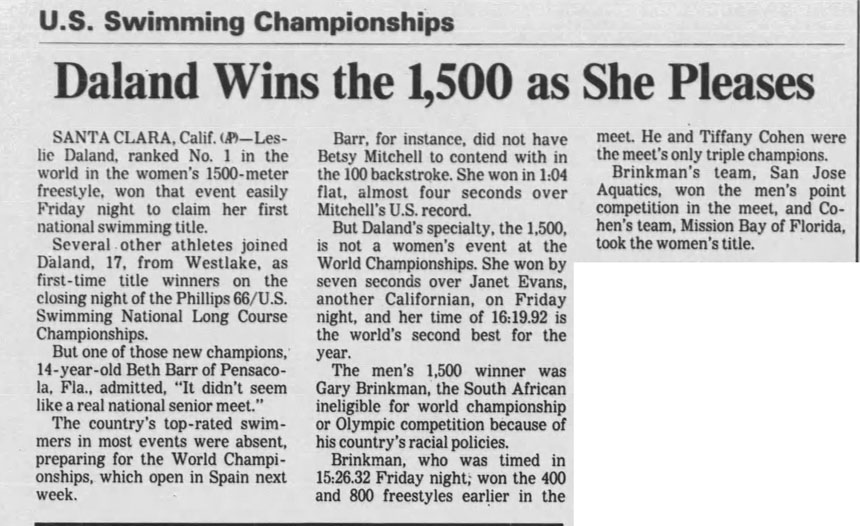
Admittedly the top US swimmer at the 1984 Olympic Games 400m freestyle finished fourth in 3:48,09. Gary felt the loss of being excluded from the Olympics keenly. In the summer of 1986, Gary Brinkman was one of two swimmers to take three titles at the US National Championships in Santa Clara. Teaming up with fellow South African exile coach Jonty SkinnerJonty Skinner at the San Jose Aquatics Club, he won the 400, 800, and 1500m freestyle events.
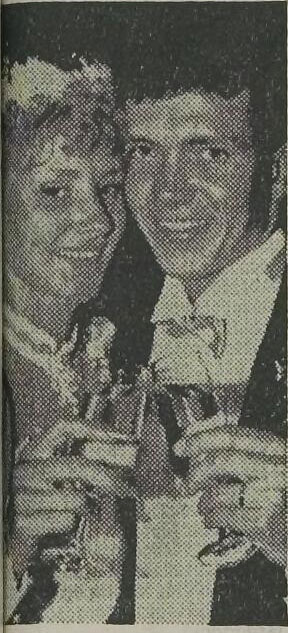
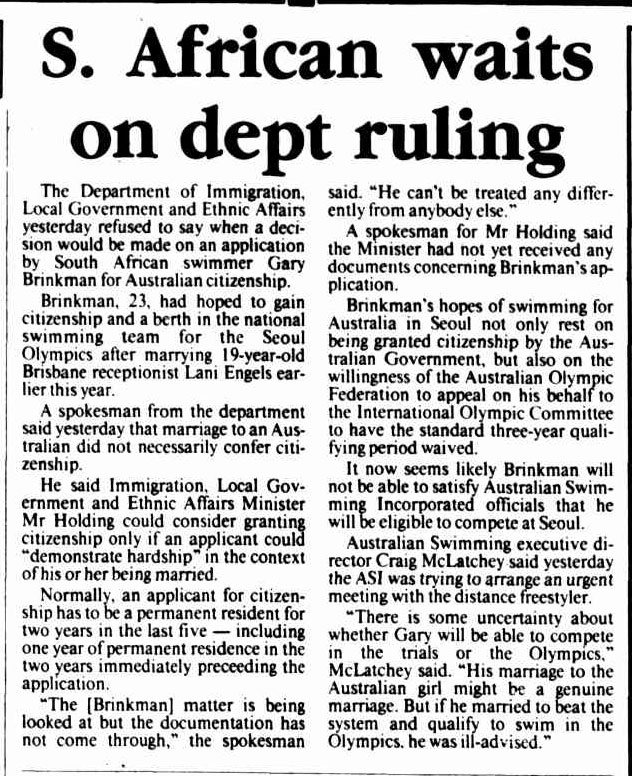
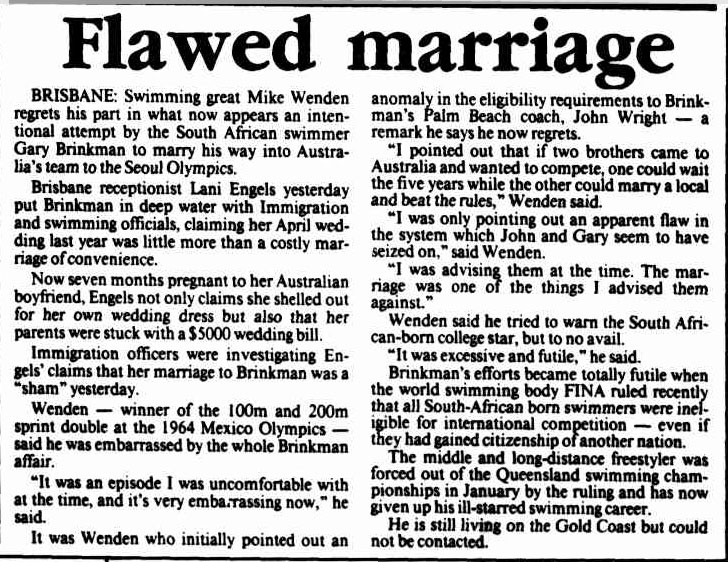
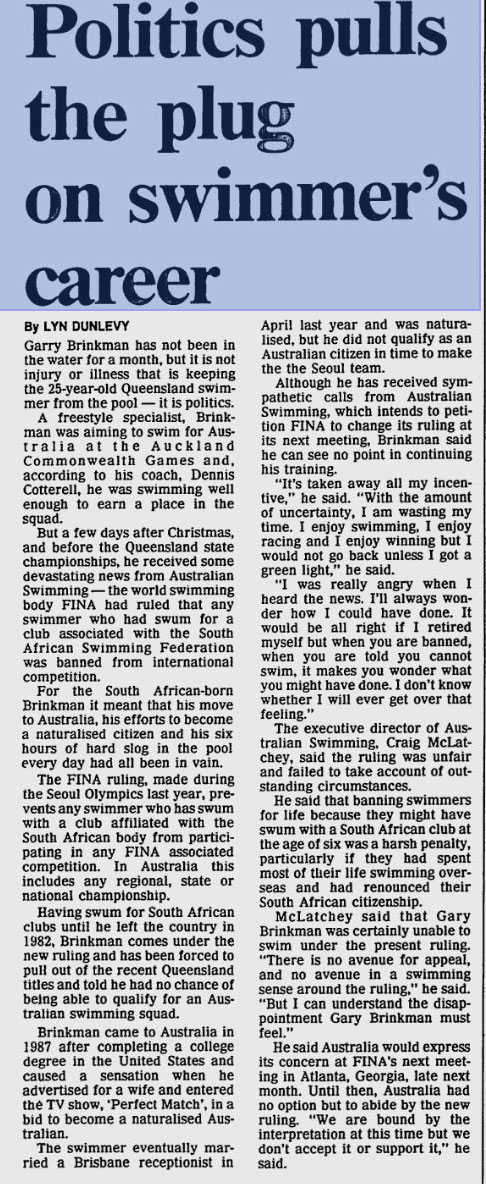
He moved to Australia after he graduated in 1986. On the Gold Coast of Australia, he swam with coach Bill Sweetenham at the Australian Institute of Sport. In Australia, he continued to swim in Queensland. where he hatched a plan to get to the Olympics in 1988. He married an Australian to get Australian citizenship. Unfortunately, the Australian government objected, and despite marriage, he was ruled ineligible to swim for Australia.
He eventually did manage to win that right - in 1992, when he did not make the Australian team to the Barcelona Olympics. He might have made the South African team, which had no 1500m qualifier. In 1994 an Australian film "Muriel's Wedding" was based on this storyline. Gary stayed on in Australia, becoming a swimming coach, and a sports photographer.
At the University of Southern Illinois:
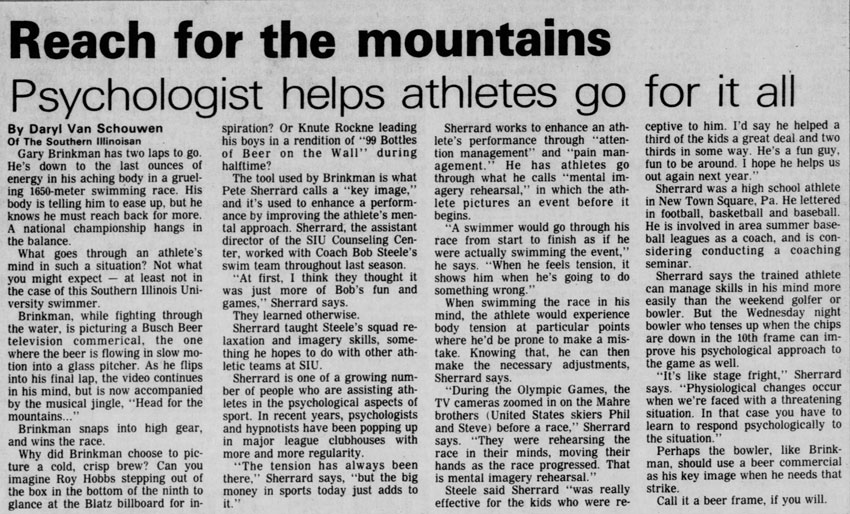
Brinkman was one of the top distance freestylers in school history and a seven-time All-American. He was a U.S. National Champion in the 400, 800 and 1,500-meter freestyle events. During all four seasons, the Salukis finished in the Top 20, and Brinkman was named the team MVP three of those years.
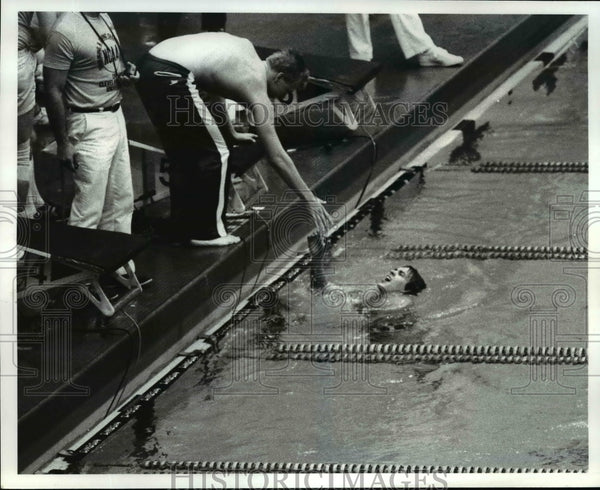
1984 NCAA 1650 yards win
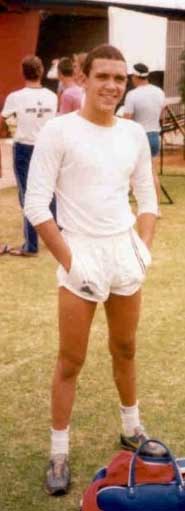
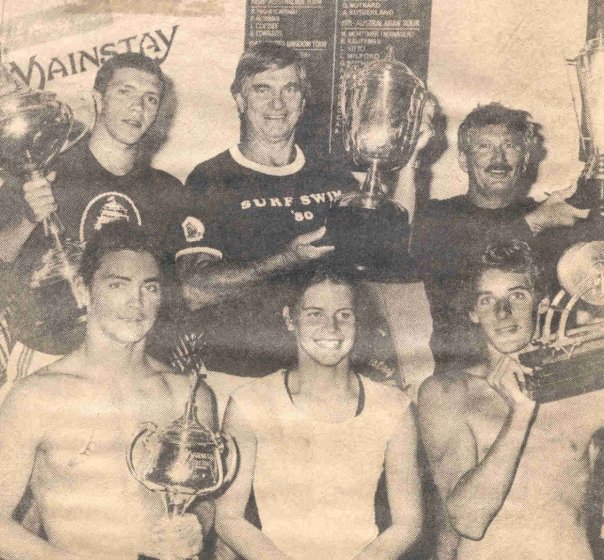
1982 Mainstay 3,2 km surf swim in Durban. Gary Brinkman shares the podium with fellow Springbok swimmers Kevin Richards and Tricia Butcher, and Surf lifesaving Bok Julian Taylor.