1928 Olympic Games

1928 Olympic Games - Amsterdam

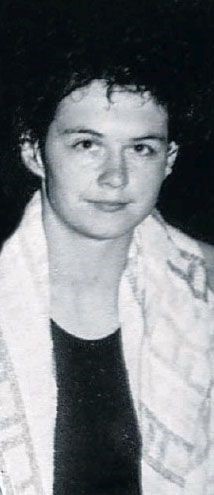
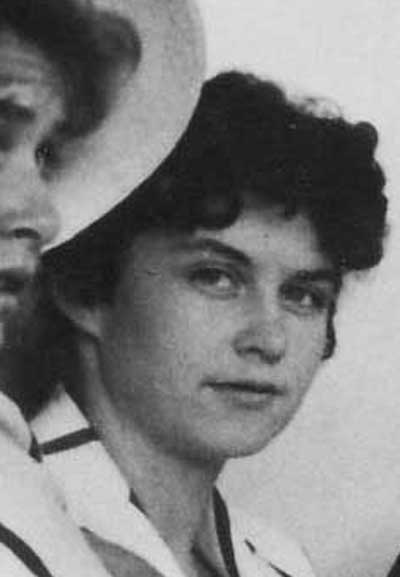
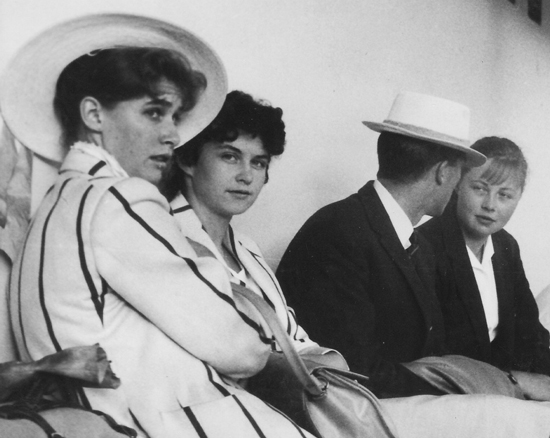
From L/R: Kathleen Russell, Zus Engelenberg, coach Rachael Finlayson, Freddie van der Goes, Rhoda Rennie.


In 1928 five South African female swimmers travelled to the Olympic Games in Amsterdam, accompanied by coach Rachael Finlayson. The won a bronze medal for finishing third in the 4x100m freestyle relay. This was the first Olympic swimming medal won by South African swimmers.

All the girls except Mary Bedford, were coached by Jimmy Green of Pretoria. Bedford was coached by Rachael Finlayson. Coach Green's swimmers had won all the women's events at the SA Swimming championships in East London in 1927, with Mary Bedford 2nd in the 50 yards freestyle. 

In Amstersdam Kathleen Russell (15) was the fastest South African swimmer, winning her heat in 1:15,4 and qualifying for the next round. Zus Engelenberg was next fastest, in 1:22,6. Kathleen did not progress after the quarter finals.

Frederica van der Goes made the final of the 400m freestyle, finishing in 5th place.

The Olympic relay race was held before the individual 100m freestyle and the result accurately foreshadowed what was to happen in that event. Only seven countries competed but qualifying heats were still needed to remove one team from the competition. This provided the opportunity for the American team to break the world record which had stood since 1924. Bolstered by the introduction of Eleanor Garatti and Martha Norelius to the team for the final, the USA swam off into the distance and took another large chunk off the world record. The British held off the Dutch for silver with South Africa touching ahead of Germany. 

The South African girls finished third in their semi-final, in 5:17,4. In the final they improved their time by 4 seconds, taking third place in 5:13,4. The Dutch women, who set a time of 5:08, in the semi's, were disqualified in the final for because Truus Baumeister started too early when taking over. The Dutch team was in second place when this happened. 

From L/R: Kathleen Russell, Zus Engelenberg, Freddie van der Goes, Rhoda Rennie, Marie Bedford. Coach Ma Finlayson from Durban, sitting in front.

Kathleen Russell

Kathleen Russell (17 November 1912 – 26 November 1992) was freestyle swimmer from Durban who competed in the 1928 Summer Olympics. She was coached by Racheal Finlayson.

At the1928 Amsterdam Olympic Games she was 15 years old, and a member of the South African relay team which won the bronze medal in the 4×100 m freestyle relay event. She also competed in the 400 metre freestyle competition, but was eliminated in the semi-finals.

At the 1934 Empire Games she won the silver medal with the South African team in the 4×100 yards freestyle relay contest.

Marie E. Bedford

Mary "Marie" Esther Bedford was born 27 March 1907 and she died in Durban on 8th September 1997. She was a member of the South African relay team which won the bronze medal in the 4×100m freestyle relay.

She also competed in the 400 metre freestyle competition, but was eliminated in the first round.

Zus Engelenberg 

Zus Engelenberg was the fifth member of the team. Born in Pretoria on 4th January 1909, she died in Durban on 16 May 1984, aged 75.

As the Northern Transvaal province was yet to be established, Zus represented Transvaal at the South African swimming championships. She was also coached by Jimmy Green in Pretoria.

At the 1934 Empire Games, she won the silver medal with the South African team in the 4×100 yards freestyle relay contest.

Frederika "Freddie" Jacoba van der Goes

In 1928 she was a member of the South African relay team which won the bronze medal in the 4×100 m freestyle relay event She also competed in the 400 metre freestyle competition and finished fifth.

At the 1934 Empire Games she won the silver medal with the South African team in the 4×100 yards freestyle relay contest.

Rhoda Rennie

Rhoda Lillian Rennie was born in Benoni in 2nd May1909. She died in Johannesburg on 11 March 1963. Her father was Major George Rennie, a Benoni pioneer estate agent and mayor,  and her mother Nellie Johanna (born Vermaak). She showed a talent for swimming at an early age, and represented Transvaal.

She competed in the 100 metre freestyle competition and in the 400 metre freestyle event, but was in both eliminated in the first round. She was a member of the South African relay team which won the bronze medal in the 4×100 m freestyle relay event.

After the 1928 Olympic Games, Rhoda married Percy Arthur Wrightson. Later in life Rhoda ran a swimming school in Johannesburg.  Rennie committed suicide by shooting herself at age 52, in Johannesburg on March 11th 1963.

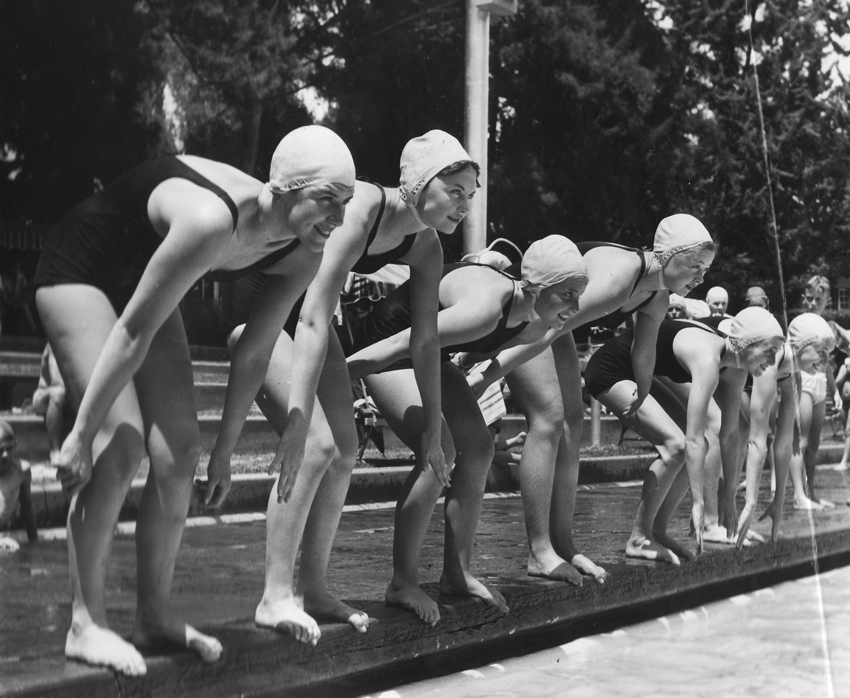
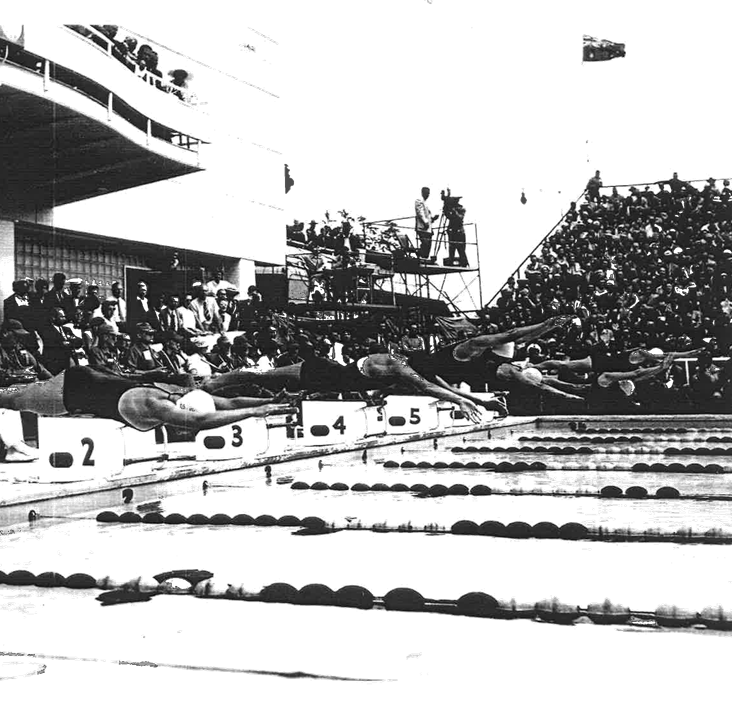
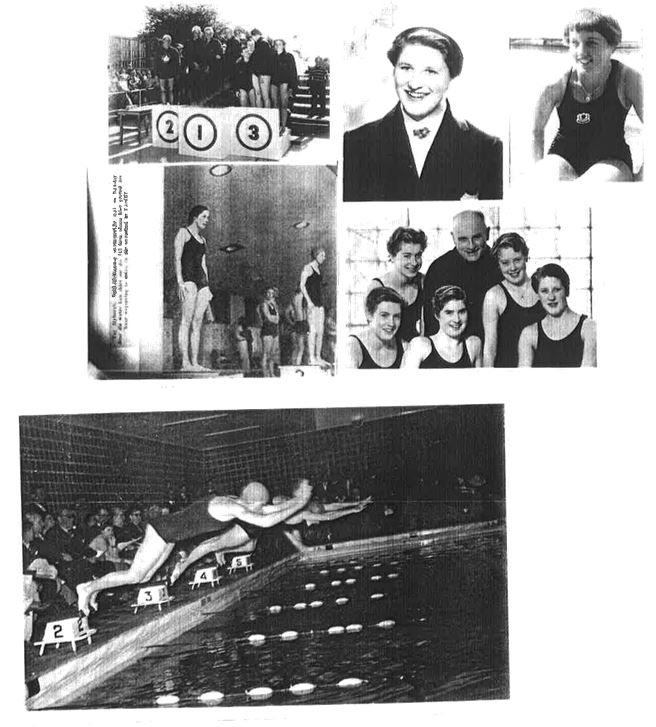
The swimming pool at the 1928 Amsterdam Olympic Games, and the start of a women's race. Constructed as the centerpiece of the 1928 Amsterdam Games, Olympisch Stadion was the gold-medal-winning work of Dutch architect Jan Wils (1891–1972), a founding member of the De Stijl movement and greatly influenced by the work of Frank Lloyd Wright. Wils accented the low-slung, redbrick structure with a slender tower that was topped with the first-ever cauldron designed to cradle the Olympic flame.

The swimming basin was made of reinforced concrete that was 50m long by 18 m wide with the deepest part near the diving area at 5 m. Stands were erected at both sides with one of them at most accommodating 6000 spectators. There were 20 men's and 16 women's dressing rooms.

A temporary structure, it was demolished following the Olympics in 1929, much to the frustration of the local swimmimers.

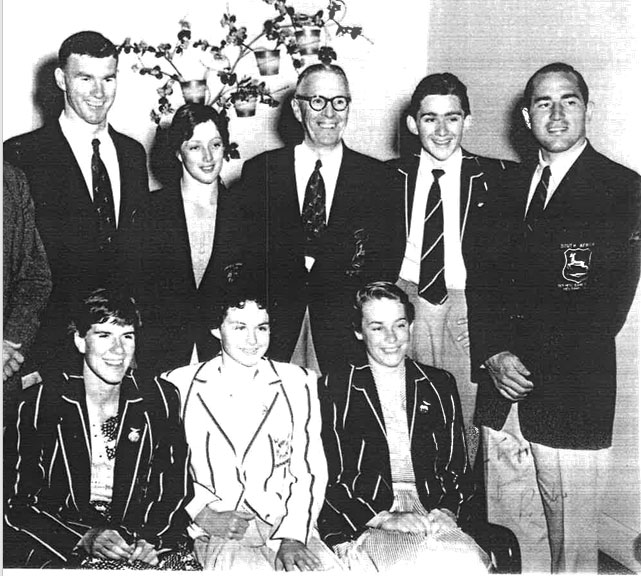
20th September 1928 - New Zealand and South African swimming team members at the Scarbrook indoor at Croydon. 

Back left: Cathleen Miller (NZ), M. Clark (SA?), coach Rachael Finlayson (SA), Zus Engelenberg (SA), Ann Stockley (NZ).

Seated: Rhoda Rennie, Frederercia van der Goes, Mary Bedford - all of SA.

Front: Kathleen Russell (SA) - winner of the race, age 15.

Scarbrook Road Baths

  • Hits: 8503

1961 - 1991

1961 - 1991

World beaters during the boycott era

Despite 30 years of the international sports boycott, South African swimmers continued to set new world records.

Karen Muir

Karen was born on 16 September 1952 in Kimberley, where she began swimming with coach Frank Gray at age 9. Three years later, on 10 August 1965 - aged 12, she became the youngest person ever to set a world record in swimming. She set a further 17 world records, before retiring in 1970.

Karen Yvette Muir →

Ann Fairlie

Ann was a contemporary and probably a role model of the legendary Karen Muir, although three years older. In 1963 Ann Fairlie became the youngest swimmer to win Springbok colours at age 13, and in 1966 she set three world records in the 100/110 backstroke. Karen Muir eclipsed her in all of these achievements, but together they dominated international women's backstroke for 5 years - without ever competing at the Olympic Games.

Ann Fairlie →

Jonty Skinner

In 1976 Jonty set a world record for the 100m freestyle. His time of 49,44 beat US swimmer Jim Montgomery's Olympic gold medal winning swim at the 1976 Games of 49,99 - just six weeks after the Olympics. His record stood for 5 years.

John Alexander Skinner →

Peter Williams

Pete set a new world record in the 50m freestyle during a time trial. Somehow FINA recognised the time - but not the record, for reasons never explained by them.

Peter Williams →

  • Hits: 5960

Joan Harrison

Joan Harrison

Clarendon High School for Girls pupil in East London Joan Harrison was just 16 years old when she won a gold medal in the 100m backstroke at the 1952 Olympic Games in Helsinki. It would be another 44 years before another South African woman won a gold medal in the pool - Penny Heyns at Atlanta in 1996.

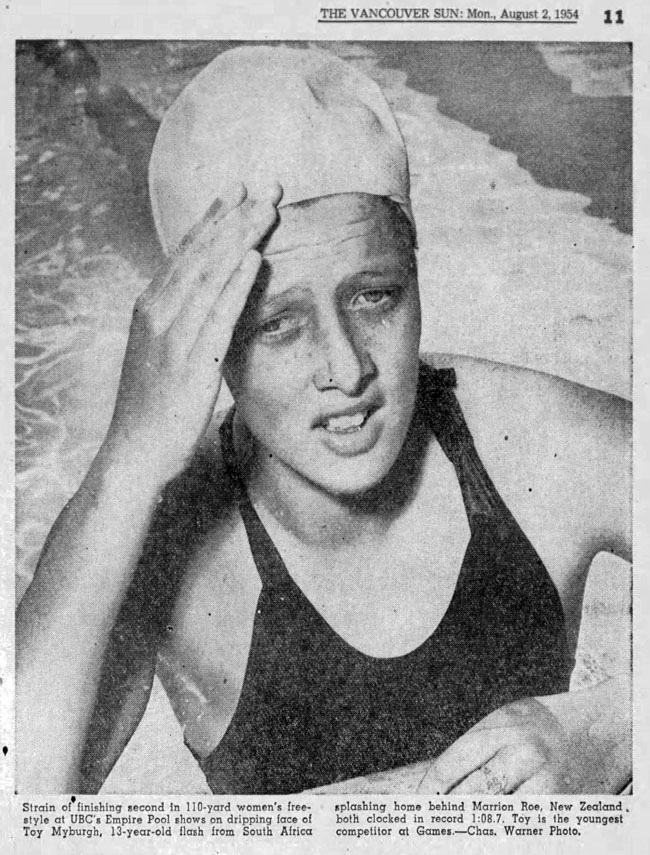
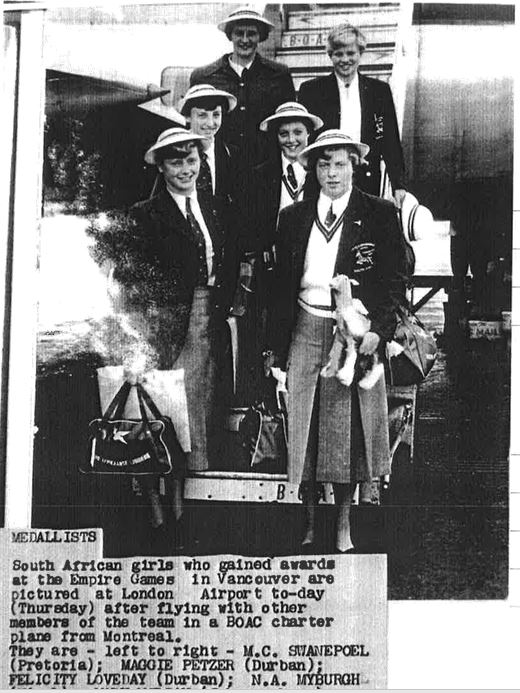
Joan had the following podium finishes at major championships: 1st in the 1952 Olympics 100 metres Backstroke; 1st in the 1950 British Empire Games 440 yards Freestyle, 1st in the 1954 British Empire and Commonwealth Games 110 yards Backstroke, 1st in the 1954 British Empire and Commonwealth Games 4×110 yards Freestyle (with Natalie Myburgh and the non-Olympians Felicity Loveday and Machduldt Petzer), 2nd in the 1954 British Empire and Commonwealth Games 3×110 yards Medley (with the non-Olympians Maggie Petzer and Mary Morgan), 3rd in the 1950 British Empire Games 110 yards Freestyle, 3rd in the 1954 British Empire and Commonwealth Games 110 yards Freestyle.

Please click here to see Joan's race in 1952.

Medallists for the Olympic women's 100m backstroke Joan Harrison, with Geertje Wielema (Neth) and Jean Stewart (NZ) at Helsinki in 1952.

Her victory in the 100-metre backstroke at Helsinki was a surprise to the whole swimming world, but not to her Manager, Alex Bulley. This excellent Swimming Manager was determined Joan could win this backstroke event and trained her according­ly in Helsinki. Although he had nothing to do with her coaching prior to Joan leaving for Finland, he took great pains to see that she trained assiduously whilst she was there. When the final race was on Alex Bulley was standing on one of the spectators' stands, and when Joan took the lead after the first turn Bulley, in his excitement, fell down the stand and "passed out". When the race was over and he found out that Joan had won the world title, he passed out again.

The swimming of our Springboks at these Games equalled any performance recorded by South African swimmers overseas and was due, to a great extent, to the training these young South Africans underwent prior to leaving the Union for the Games and also during their stay in Helsinki. At the 1954 Games in Vancouver, she won gold in 110yds in the backstroke; 4x110yds freestyle relay, silver in the 3x110yds medley relay, bronze in the 110yds freestyle.

 Family

Coach Bunny Clark with the Harrison family

For these achievements she was inducted into the International Swimming Hall of Fame in 1982.

Born in 1935 of a swimming mother and a rugby-playing father in East London, South Africa, Joan Harrison wasted little time taking advantage of her sporting heritage. At 13, she already held three Jr. and two Sr. national records, and that year won the 220 and 500 yd. Senior Freestyle National Championships.

In 1950, at age 14, she won the 440 yd. freestyle at the Commonwealth Games in Auckland, New Zealand, beating the old record by 13 seconds and finishing 7 seconds ahead of the field. It was her first international competition and she was declared the outstanding woman swimmer in the Games.

Her second International Games was the Helsinki Olympics in 1952, where she won South Africa's first and only Olympic gold medal for swimming. In 1954, at the Commonwealth Games in Vancouver, she won two gold medals, a silver, and a bronze before retiring at the ripe old age of 17.

She won the Helms Foundation Award for the best African athletic performance in any sport in 1952, and while concentrating on field hockey after 1954, she did manage to come back two more years to win the Nationals in her favourite 100-meter backstroke and in the 300 I. M. in 1956.

She was South Africa's supreme swimmer in freestyle, backstroke and I.M. for six years.

Picture8

Olympic gold medallist Joan Breetzke, (nee Harrison) displays the gold medal she won at the Helsinki Olympics in 1952. The picture depicts her amazing welcome from thousands of East Londoners upon her return from Europe.

Sixty years ago East London swimmer Joan (Harrison) Breetzke, swam to a gold medal in the backstroke at the Helsinki Olympics. Speaking to the Daily Dispatch from her Selborne home Breetzke reminisced about the day her name went down in the history books. “I remember I had a busy week. Even on the day, there was a dilemma about doing the race because I did 400m freestyle in the morning. So I rested at lunchtime and did the 100m at 5 pm,” Breetzke said.

She said she went to the Olympics prepared to do her best, but never expected to win. Her Olympic winning time was 1:14.3 for the 100m backstroke. “I did not put too much pressure on myself. I was not the favourite, the girl from Holland [Geertje Wielema] was. Team South Africa was made up of more than 80 people and I was the only female swimmer.” The soft-spoken woman said she did not particularly enjoy the attention she was receiving, but she was grateful for all the support. “People made a fuss about it. But my life did not really change. I was still an ordinary girl from East London. When we arrived back in the city there were thousands of people waiting for me at the city hall.

I even drove down Oxford Street in an open-top car,” she said, adding that she lived life as normally as possible after that.

Picture14

Oos Londen heldin onthou goud van 1952

Vier-en-veertig jaar gelede het tienduisende mense in die strate van Oos-Londen saamgedrom om een van Suid-Afrika se laaste Olimpiese gouemedalje-wenners 'n oorweldigende verwelkoming te gee. Gister het Joan Harrison Breetzke, wenner van die 100m-rugslag in 1952 in Helsinki, 'n telegram van gelukwense aan Penny Heyns, Suid-Afrika se eerste gouemedalje-wenner sedert Harrison Breetzke en Esther Brand dit laas verower het, in Atlanta gestuur.

``Baie geluk met jou wêreldrekord Welkom tot Goud Joan Harrison Breetzke (100m-rugslag in Helsinki 1952),'' het die boodskap gelui. Harrison Breetzke het gister aan Die Burger gesê: ``Ek is baie bly vir Penny se onthalwe dat sy 'n goue medalje verower het. Dit is 'n groot oomblik vir Suid-Afrika en ek weet baie goed hoe trots en emosioneel sy op die wenners- podium moes gevoel het. Ek onthou goed hoe emosioneel ek as 'n 16-jarige gevoel het.'' Sy sê sy onthou die oorweldigende blydskap van haar Suid-Afrikaanse spanmaats die meeste nadat sy die medalje verower het. ``Hulle het op my afgestorm, omhels en aanhoudend gelukgewens.''

Oorwinning 'nie maklik' Haar oorwinning was nie maklik nie. Die Saterdag vóór haar sege het sy meegeding in die 100 m-vryslag. Oor die eerste plek was daar geen twyfel nie, maar drie swemmers het omtrent gelyk klaargemaak in die tweede plek. Harrison Breetzke was een van hulle, maar die beoordelaars het haar vierde geplaas. Haar afrigter, Alex Bulley, oortuig daarvan dat sy van 'n tweede plek beroof is, het haar gemotiveer en meer vasberade gemaak vir die 100m-rugslag die volgende Donderdag.

Sy was nie die gunsteling nie, maar het van nêrens gekom en die Nederlander Geertje Wielema en die Nieu- Seelander Jean Stewart uitgestof om met die goue medalje weg te stap. Met haar terugkeer na Oos-Londen is sy soos 'n heldin terugverwelkom. Sy het in 'n afslaankap-motor deur die strate gery terwyl derduisende mense langs die strate gestaan het. Harrison Breetzke het in die somer en winter in die Quanza, 'n seewater swembad by Orient Strand in Oos- Londen, geoefen.

Wanneer sy in die winter saans by die huis gekom het, het haar ma haar in warm komberse toegedraai voordat sy in 'n warm bad gestop is. Die koue het in 1954 tot haar ont trekking uit die Statebond Spele gelei toe sy nie meer die koue water van die seeswembad kon hanteer nie. Harrison Breetzke is die ma van drie uitblinker seuns. Jon is 'n Springbok waterpolospe ler, Derek 'n junior Springbok in lewensredding en Brian het Suid-Afrikaanse kleure verwerf in lewensredding en 'n goue medalje verower op die onlangse lewensredding-wêreldkampioenskapsbyeenkoms.

Joan Harrison, who won the back stroke swimming title in 1950 in New Zealand, when still a schoolgirl, did her training in her home town when her scholastic duties permitted her to do so. Her victory in the 100-metres backstroke at Helsinki was a surprise to the whole swimming world, but not to her Manager, Alex Bulley. This excellent Swimming Manager was determined Joan could win this backstroke event and trained her according­ly in Helsinki. Although he had nothing to do with her coaching prior to Joan leaving for Finland, he took great pains to see that she trained assiduously whilst she was there. When the final race was on Alex Bulley was standing on one of the spectators' stands, and when Joan took the lead after the first turn Bulley, in his excitement, fell down the stand and "passed out". When the race was over and he found out that Joan had won the world title, he passed out again.

The swimming of our Springboks at these Games equalled any performance recorded by South African swimmers overseas, and was due, to a great extent, to the training these young South Africans underwent prior to leaving the Union for the Games and also during their stay in Helsinki.

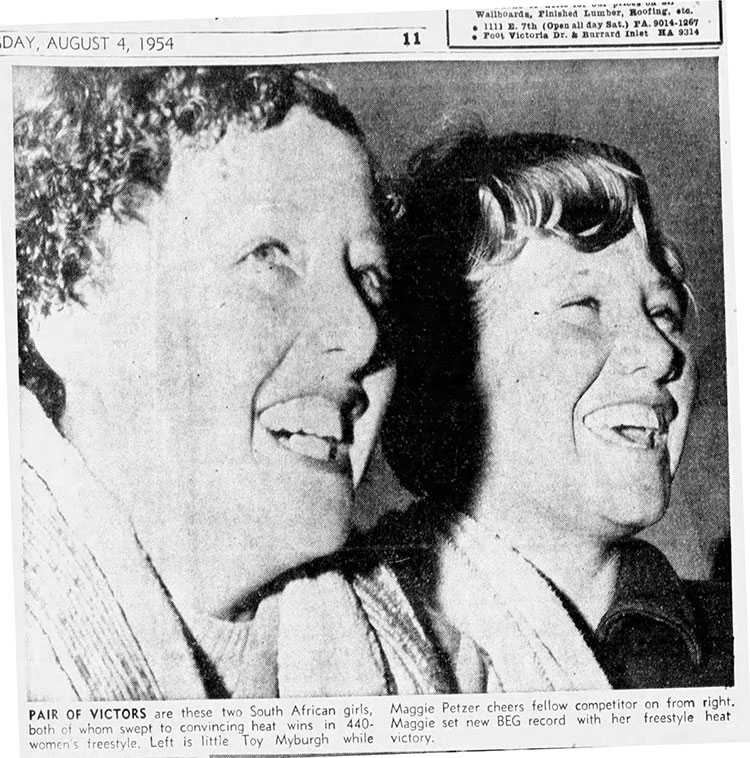
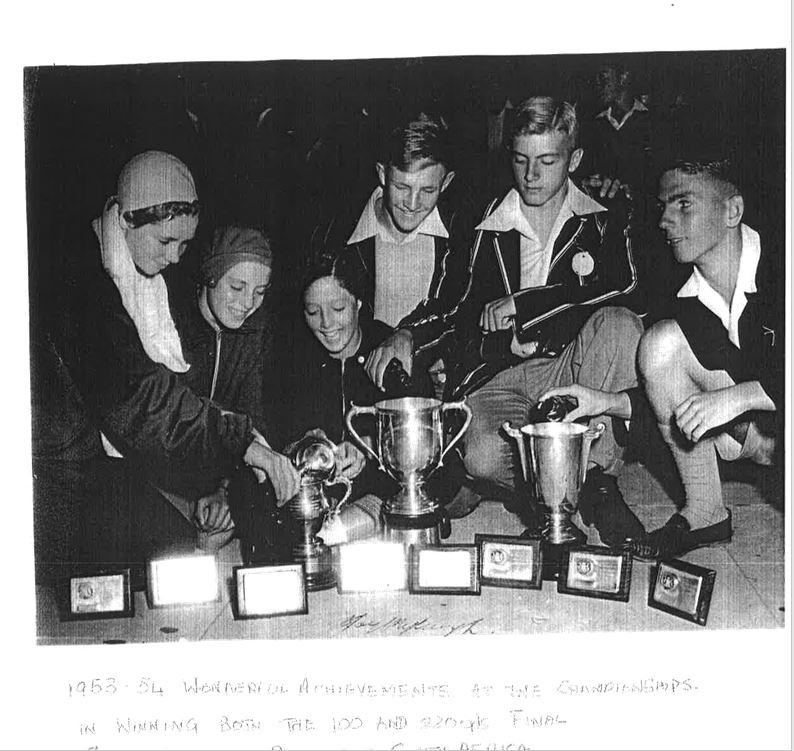
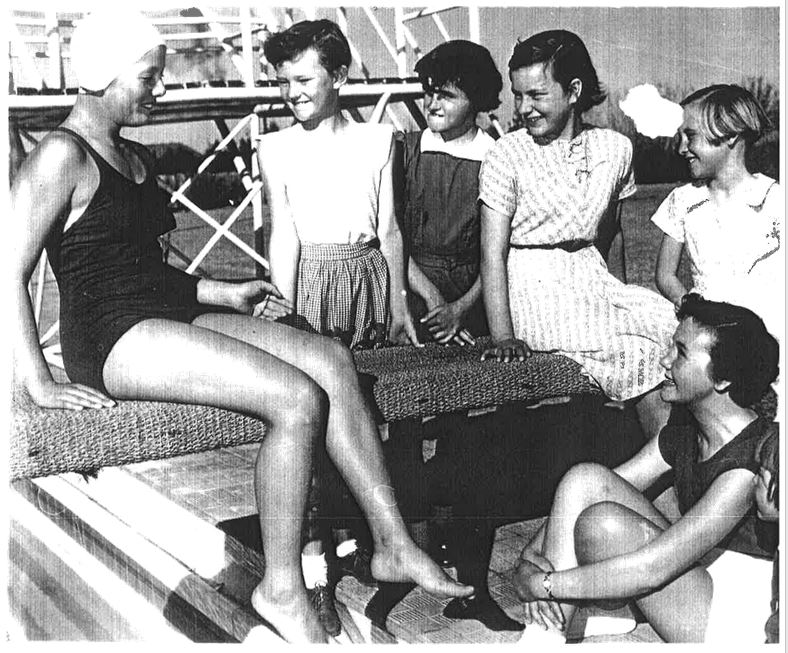
Joan congratulates Maggie Petzer for beating her at nationals in 1954 -  with Felicity Loveday

Coach C.H. "Bunny" Clark poke about his 5 rules and the 10 commandments of good sportsmanship at a Coaching Clinic in 1949.

-You shall not Quit
-You shall not Alibi
-You shall not Gloat over winning
-You shall not Gripe over losing
-You shall not take unfair advantage
-You shall not ask odds that you are not willing to give
-You shall never be willing to concede your opponent the edge
-You shall not underestimate your opponent or overestimate yourself
-Remember, the Game is the thing and he who thinks otherwise is no true sportsman
-Honour the Game you play, for if you play the Game straight and hard, you Win, even when you Lose

  • Picture 7

  • Picture 10

  • Picture 11

  • Picture 19

Joan Harrison (RSA)

Honor Swimmer (1982)

The information on this page was written the year of their induction.

FOR THE RECORD:  OLYMPIC GAMES: 1952 gold (100m backstroke); COMMONWEALTH GAMES: 1950 gold (400m freestyle), bronze (100m freestyle); 1954 gold (100m backstroke; relay), silver (relay), bronze (100m freestyle).

Born in 1935 of a swimming mother and a rugby-playing father in East London, South Africa, Joan Harrison wasted little time taking advantage of her sporting heritage.  At 13, she already held three Jr. and two Sr. national records, and that year won the 220 and 500 yd. Senior Freestyle National Championships.  In 1950, at age 14, she won the 440 yd. freestyle at the Commonwealth Games in Auckland, New Zealand, beating the old record by 13 seconds and finishing 7 seconds ahead of the field.  It was her first international competition and she was declared the outstanding woman swimmer in the Games.  Her second International Games was the Helsinki Olympics in 1952, where she won South Africa’s first and only Olympic gold medal for swimming.  In 1954, at the Commonwealth Games in Vancouver, she won two gold medals, a silver, and a bronze before retiring at the ripe old age of 17.  She won the Helms Foundation Award for the best African athletic performance in any sport in 1952, and while concentrating on field hockey after 1954, she did manage to come back two more years to win the Nationals in her favorite 100 meter backstroke and in the 300 I. M. in 1956.  She was South Africa’s supreme swimmer in freestyle, backstroke and I.M. for six years.

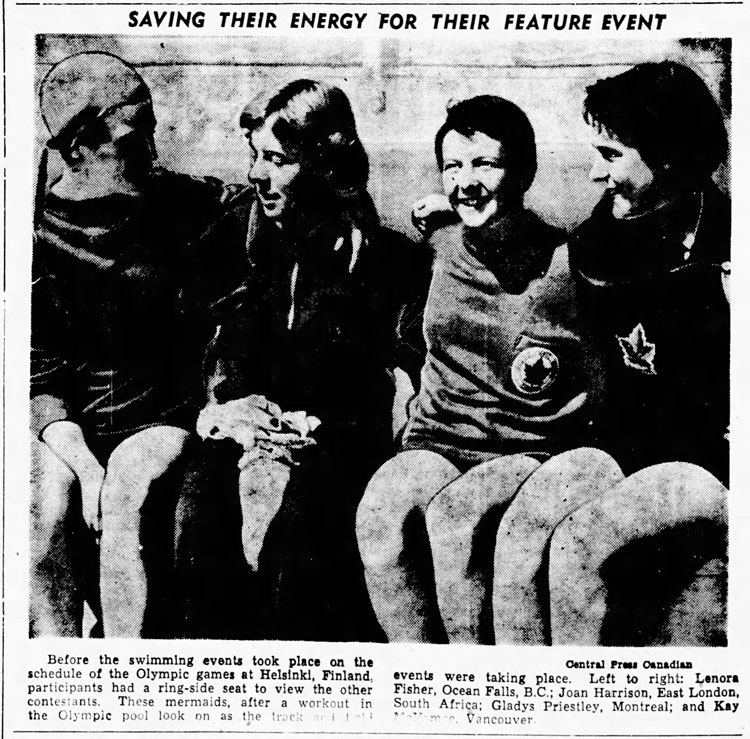
Canadian swimmer Lenora Fisher, South African swimmer Joan Harrison, Canadian swimmer Gladys Priestley, and Canadian swimmer Kay McNamee, take a break during a training session at the Helsinki Swimming Stadium, during the 1952 Summer Olympics in Helsinki, Finland, 18th July 1952. (Photo by Popperfoto/Hulton Archive/Getty Images)

Champions, Sports

  • Hits: 8894

1900 - 1960

1900 - 1960

In 1912 George 'Looper' Godfrey became the first Springbok swimmer when he competed at the Helsinki Olympic Games, without medal success. George "Looper" Godfrey was a legend of South African swimming, who dominated men's events before the war. In 1909 he won all the swimming events - 100, 220 and 500 freestyle - and he still swimming at nationals by 1920. Full name: George Albert Godfrey Nickname(s): Looper Born: July 26, 1888, in Durban, Natal, South Africa Died: May 22, 1965(Aged 76) in Durban, Natal, South Africa

South Africans won their first Olympic medal in swimming when the women's 4x100m freestyle relay finished in third place at the 1928 Olympic Games in Amsterdam. 

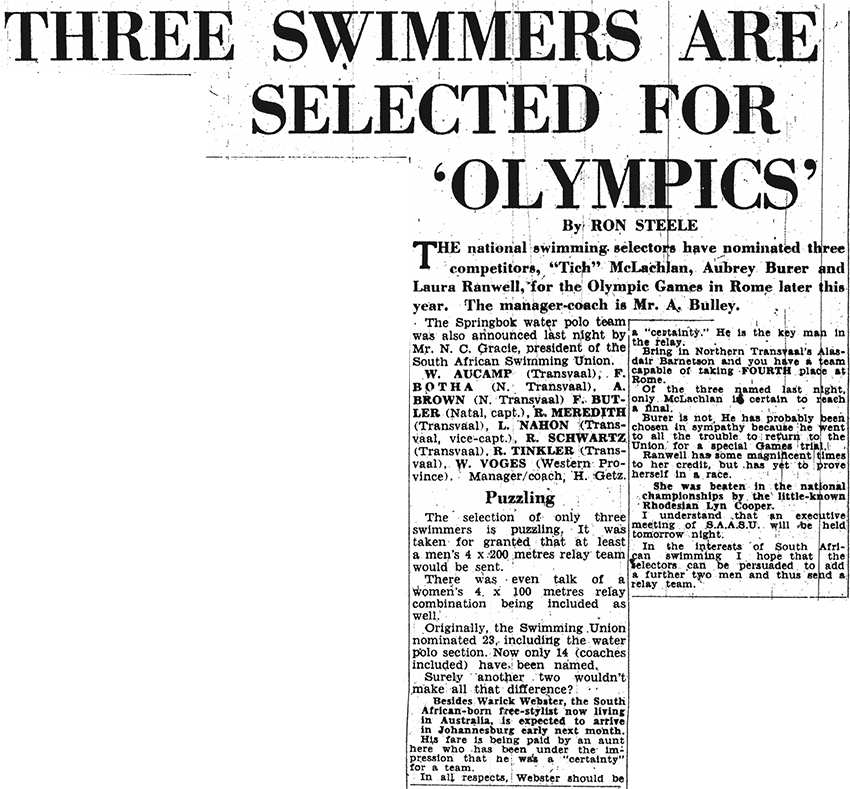
In 1952 Joan Harrison won the first South African Olympic swimming gold medal, and women won another relay medal at Melbourne in 1956. The era ended with Laura Ranwell setting an Olympic record at Rome in 1960, where Natalie Stewart of Pretoria and Rhodesia competed for Great Britain, winning two medals.

Joan Harrison won the 100 freestyle at the 1952 Olympic Games in Helsinki.

Read more about Joan Harrison →

1928 Amsterdam Olympic Games

The bronze medal-winning Springbok women's relay team of Kathleen Russell, Freddie van der Goes, Marie Bedford and Rhoda Rennie.

Women win first medal →

Jennie Maakal

Jenny Genoveva Maakal competed in the 1932 Summer Olympics winning the first individual Olympic medal for South AFrica - a bronze medal in the 400 m freestyle event. She also placed sixth place in the 100m freestyle.

The first individual medal winner →

Joan Harrison

A native of East London, attending Clarendon High School for Girls, she swam at the 1952 Olympic Games in Helsinki, winning a gold medal in the women's 100 m backstroke.

Her story → 

 1956 Melbourne Olympic Games

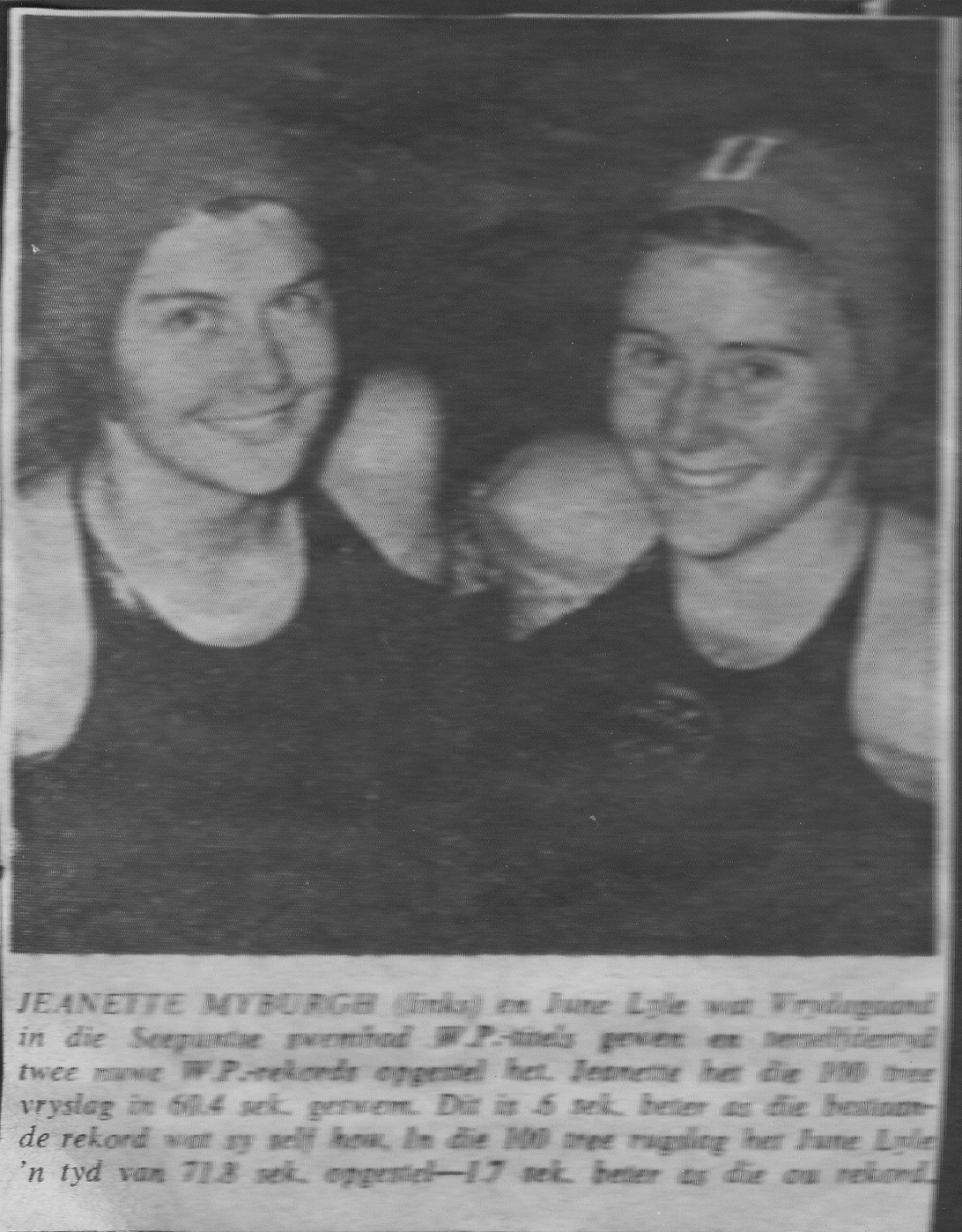
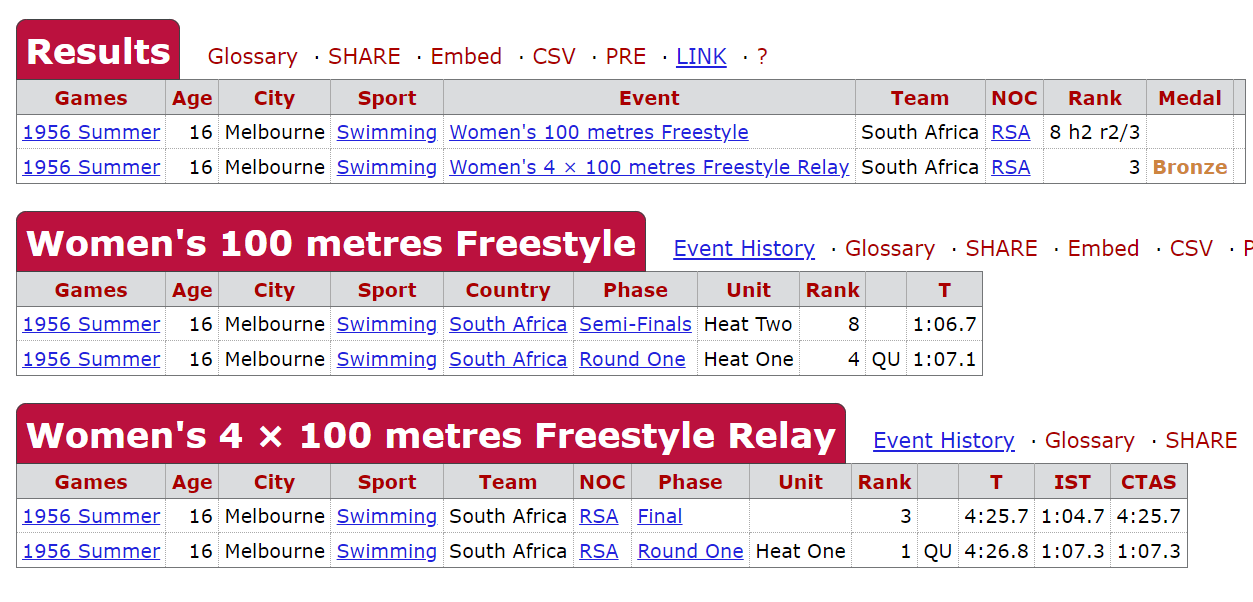
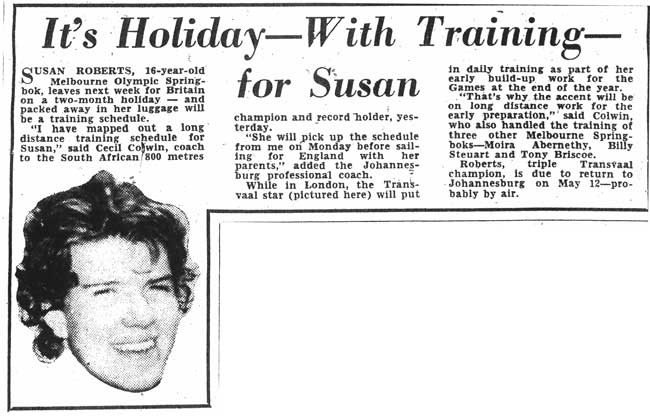
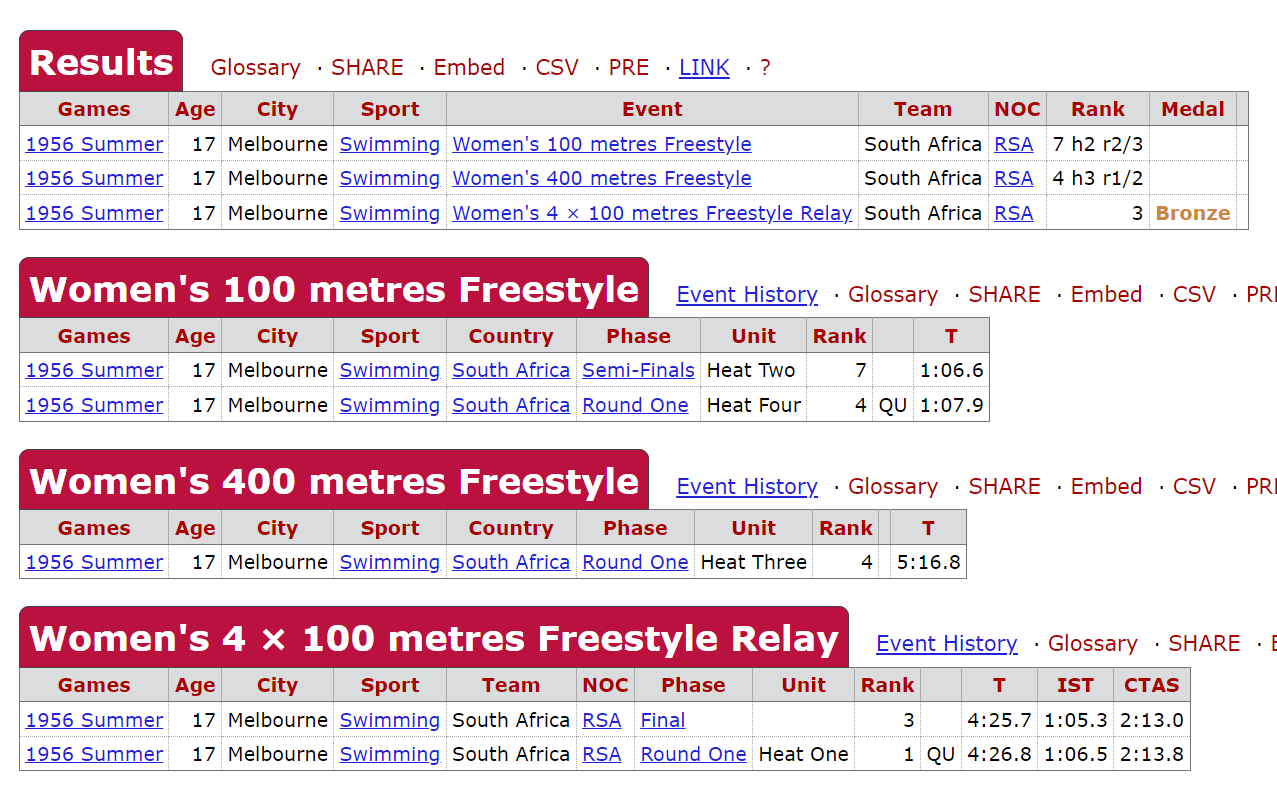
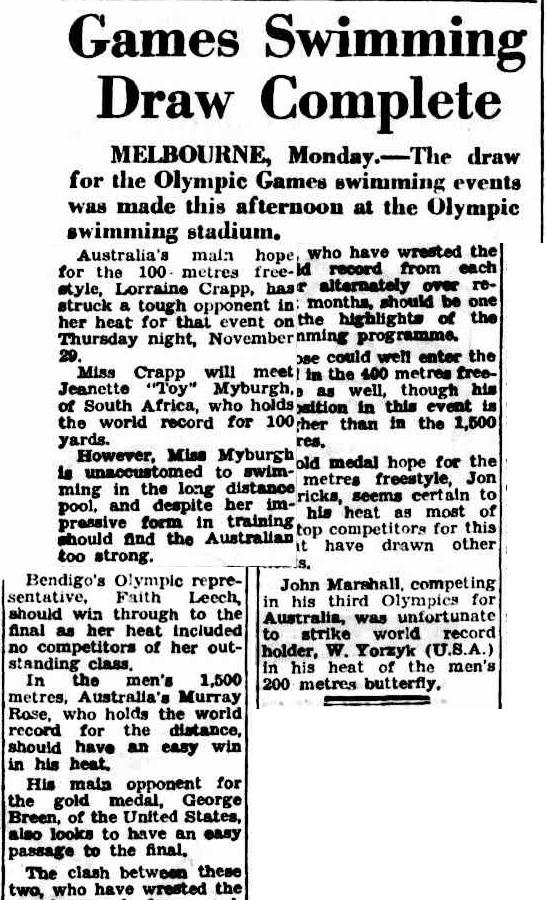
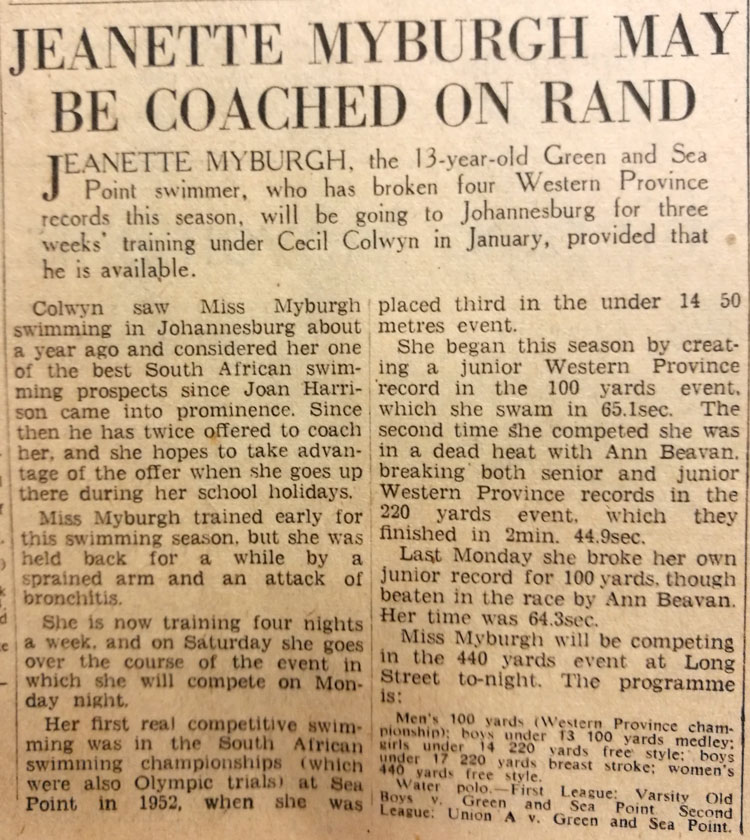
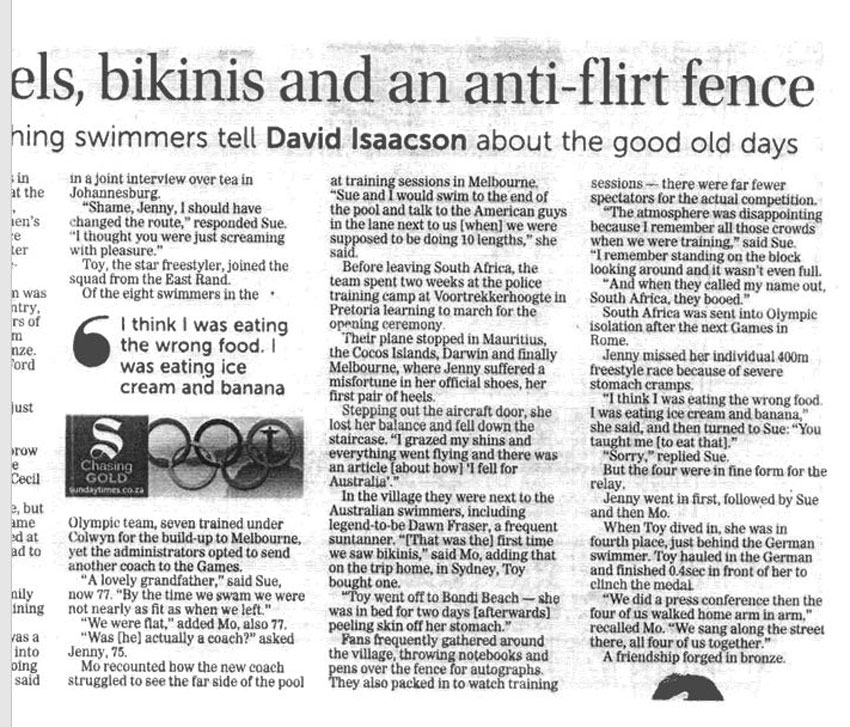
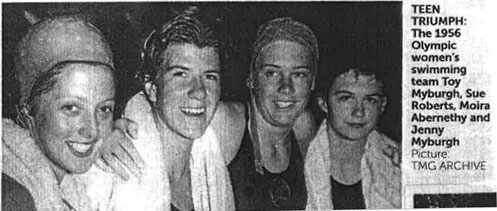
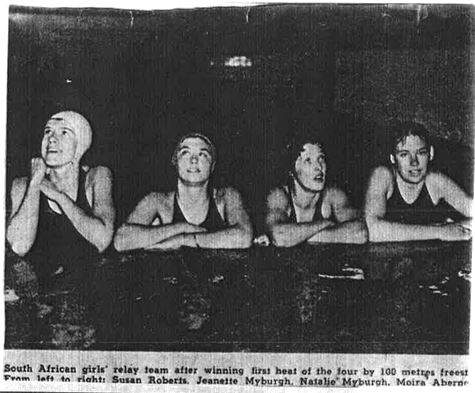
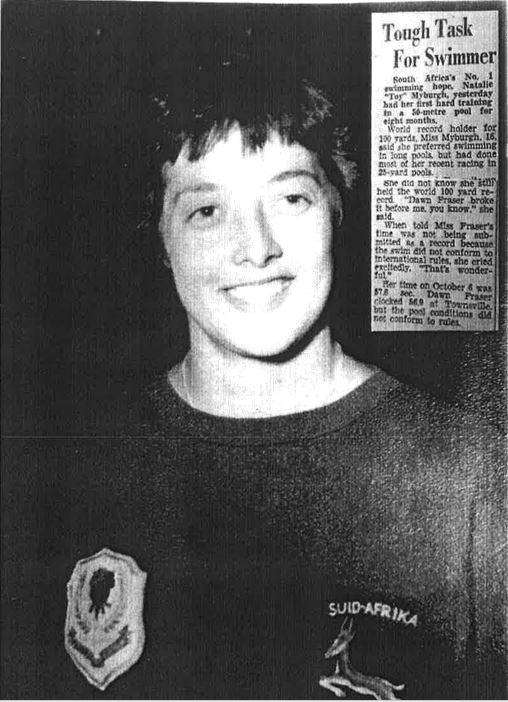
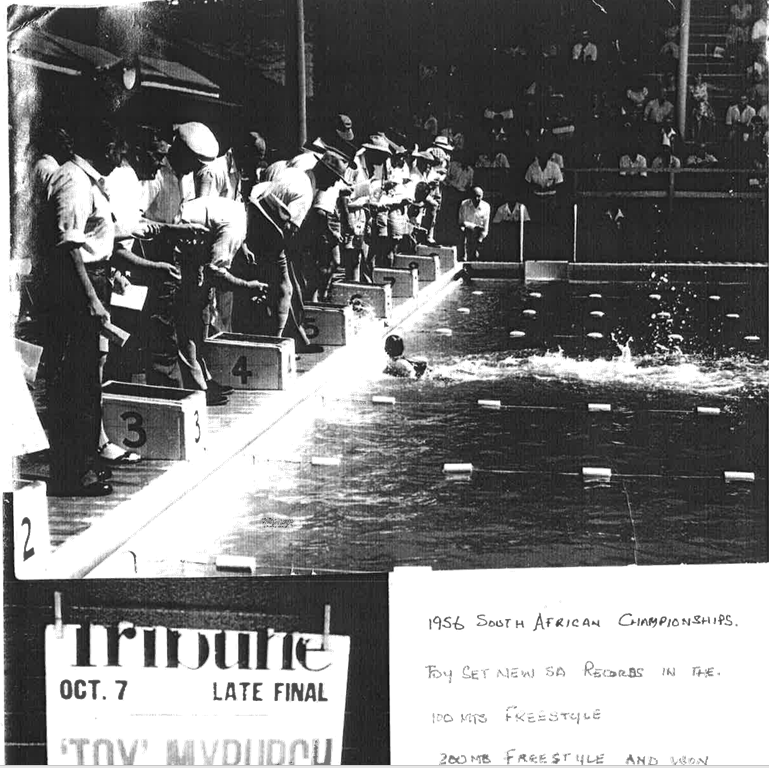
The South African women's team of Moira Abernethy, Natalie Myburgh, Susan Roberts and Jeanette Myburgh won bronze in the 4 x 110yds freestyle relay.

Another ladies relay medal →

Laura Ranwell

In the 1960 Rome Olympic Games women's 100m backstroke Laura set an Olympic record in her heat, and in the final she finished with an equal time as the bronze medallist, although she was placed 4th.

Olympic record breaker →

Champions, Karen Muir, Joan Harrison

  • Hits: 7895

Karen Muir

Karen Muir - world record holder, docter and mother.

The Beginning [1]

When I reflect on my swimming career and ask myself if it was all worth the effort, I would say YES without hesitation. But I would never allow a daughter of mine to go on an international tour at the age of twelve. And unless the academic system in our schools changes radically, no child of mine will spend as much time on sports as I did.

I learned to swim at the age of nine. The following year I represented Griqualand West at the SA schools championships in Port Elizabeth. I took part in the 110-yard freestyle and finished LAST!

Maybe I should have stopped then and grown up like a normal little girl. But no, coach Frank Gray would not allow it. At the age of eleven I took part in my first Currie Cup tournament, again in Port Elizabeth.

Springbok Team

The next year, at the age of twelve, I was selected for the Springbok team that competed in Europe after the SA championships in Salisbury.

At this time, South Africa's world record pioneer, Ann Fairlie, was already  established as a major name in our swimming world. Ann, a few years older than myself, beat me in Salisbury. Over the next three years this great Cecil Colwin product would spur me on past her own world class performances in the backstroke several times.

Carefree Childhood

The moment the plane took off for the first tour, my life was split in two. There was Karen the carefree child who for the next six years just wanted to pass every standard at Diamantveld High School in the first class; and there was Karen Muir, at the beginning of an exhausting career as an international swimmer.

The day of the British championships in Blackpool arrived and for a country girl who said on television that Rome reminded her of Kimberley, it was a great emotional experience.

World Record

I could never participate in the Olympics, but I doubt if anything would have made a bigger impression on me after the British championships at Blackpool, my first major international event.

I remember closing my eyes tightly as I plunged into the water for my first heat. And from the moment the shot was fired, until I reached the end, I was aware of only one thought: “Swim, Karen, swim; swim harder; swim, you have to reach the final.”

It was only when Mr Alex Bulley rushed towards me and hugged me and that photograph was taken where I stood dazed and crying with my fingers in my mouth, that I realised something momentous had happened. I can honestly say that Mr Bulley's repeated assurances that I had set a new world record just did not sink in.

Shy Karen

Shy Karen, they called me, and it just made me even more uncomfortable and flustered. I mean, did they really expect a twelve-year-old country girl to be world-wise?

I do not want to talk about sacrifices: if one wants to achieve the highest level in any field, it does not come without sacrifice. But hours of effort and exercise in the pool, day by day, while other children play without a care? A child in a adult world? Let's not go there.

What kind of girl is Karen? – Anna van Andel

What kind of girl is Karen? Ask her grandmother, Anna van Andel, who flew to Durban this past weekend to see the most famous of her eight grandchildren set a new world record. "She is a very normal child and we do not make a fuss of her," replied grandmother Van Andel. "She is now much more relaxed amongst people, but before she went overseas in August last year, she was extremely shy. She never went anywhere unless her father, mother or sisters were with her, not even for a weekend outing.

Karen is in her element in the outdoors. On the Muirs' farm, Bosduiwekop, near Douglas, there is a tall shepherd’s tree (boscia albitrunca), and she and her sisters, Linda and Liana, play in the tree as often as they can. Although Karen only started swimming competitively just more than three years ago, she has had many setbacks. Two years ago she had her appendix removed. Since then she has constantly suffered from the flu and sinus infections.

When she returned last August after setting the world record in Blackpool, England, she developed an ear infection that kept her out of the pool for weeks. People see her walking around with a woollen cap over her ears and they often ask why, not realising that the doctors said she should constantly guard against ear infection.

She had just recovered from this infection in October (1966) when on November 6 she tore a muscle in her leg and she had to hop around on crutches. Once this healed, performances awaited her in Pretoria, Johannesburg, Durban, Mafikeng and Cape Town. This interfered with her exercise schedule. Beginning of January this year, she injured a muscle in her back. Last week when she set the world record, Karen had still not fully recovered.

As Karen achieved more and more in the pool, so her schoolwork improved. At the end of last year, she stood first in the Std 5 class of Diamantveld Primary School. She devotes herself completely to her schoolwork and reads a lot. When Grandma Van Andel is asked what the secret to her granddaughter's success is, she ascribes it to determination and dedication. “When Karen decides on some-thing, you do not move her easily from her decision.”

The greatest sacrifice was made by my parents. They are the ones who made it possible for me to swim for South Africa for six years and to maintain a world level throughout.

It must be remembered that from the age of eleven until my matric year I was rarely at home during the swimming season. Almost every weekend I had to swim in another town or city, also doing showcase swims – often in the most remote little towns. There were the provincial and national championships, competitions against visiting teams. In April every year there were competitions abroad, then back in May, then to a facility with heated pools to prepare for the winter season, since Kimberley did not have such facilities. July overseas again, back mid-August.

Schoolwork

And then suddenly I had to catch up the full load of the school curriculum for that year – each and every one of those six swimming years. Just two months to complete the syllabus, because in November the new swimming season started up again.

At great expense my parents had to enlist the help of outside teachers to get me ready for the exams with extra lessons.

These are the circumstances that cause so many of our young swimmers to fade academically. And you must remember that one is away from home during the years that a child, and especially a girl, is most susceptible to outside influences. That my parents managed to keep me on course, to make me the first Springbok swimmer, so I understand, who was able to pass matric with a first class, is their own amazing achievement. I will never be able to thank them enough for this.

When I started university to qualify as a doctor at the UOFS I had to give up swimming. But I was just as determined to become Karen Muir MD as I was when I was aiming for world records!

 Reflection

I really enjoyed my career as a medical doctor. I had a practice in Ladysmith, Natal for 22 years, and also in Canada.

======

Karen left South Africa because she was looking for new experiences. "I got a bit bored and I also wanted to go and see what it is like over there.”

Swimming did not come naturally to her. "Look, I was scared of the water. At school a Dr. Oberholtzer held swimming galas on Saturdays across the width of the pool. He used sweets as an incentive, so I started swimming.

[1] This chapter is based on an interview conducted with Karen and duplicated on the website www.swimhistory.co.za. The original source, however, could not be determined.

Translation thanks to Chris Steyl

Karen Muir - wêreld rekordhouer, dokter en moeder

In haar eie woorde:

As ek nou terugkyk en myself die vraag stel of dit alles die moeite werd was, dan moet ek sonder aarseling JA sê. Maar ek sal nooit ‘n twaalfjarige dogter van my toelaat om op buitelandse toere te gaan nie – en tensy die akademiese stelsel in ons skole radikaal verander, sal geen kind van my so baie tyd aan sport bestee soos ek gedoen het nie.

Ek het op die ouderdom van nege geleer swem. Die volgende jaar het ek Griekwaland-Wes op die S.A Skole-kampioenskappe in Port Elizabeth verteenwoordig. Ek het aan die 110 tree-vryslag deelgeneemen HEEL LAASTE geëindig!

Miskien moes ek toe opgehou en soos ‘n normale dogtertjie groot geword het. Maar nee, afrigter Frank Gray het dit nie toegelaat nie. Op 11-jarige leeftyd het ek aan my eerste Curriebeker toernooi, weer in Port Elizabeth, deelgeneem.

SPRINGBOKSPAN

Die daaropvolgende jaar, twaalf jaar oud, is ek na afloop van die S.A Kampioenskappe in Salisbury vir die Springbokspan wat na Europa gegaan het, gekies.

Teen hierdie tyd was Suid-Afrika se wêreldrekord-baanbreker ANN FAIRLIE, reeds gevestig as ‘n groot naam in ons swem. Ann, ‘n paar jaar ouer as ek, het my in Salisbury geklop. Die volgende drie jaar sou hierdie puik Cecil Colwin-produk my verby haar eie wêreldtye in die rugslag dryf.

POPSPEEL-KIND

Die oomblik toe die vliegtuig styg, het my lewe in twee geskeur. Daar was Karen die popspeel-kind wat vir die volgende ses jaar graag elke standerd op die Hoërskool Diamantveld in die eerste klas wou slag; en daar was Karen Muir, aan die begin van ‘n uitputtende loopbaan as internasioenale swemster.

Die dag van die Britse kampioenskappe in Blackpool het aangebreek en vir ‘n vaal ou Kalahari-dogtertjie wat op beeldradio gesê het Rome herhinner haar aan Kimberley, was dit ‘n geweldige emosionele belewenis. 

WÊRELDREKORD

Aan die Olimpiese Spele kon ek toe nooit deelneem nie, maar ek twyfel of enigiets daarna ‘n groter indruk op my sou gemaak het as the Britse Kampioenskappe, my eerste groot internasioenale byeenkoms.

Ek hetmy oë styf toegeknyp toe ek werktuiglik in my eerste uitdun in die water gedons het. Van die oomblik toe die skoot geknal het, totdat ek die eindkant geraak het, was ek net van een gedagte bewus: swem, Karen, swem, swem harder swem, jy moet die finaal haal.

Alleen toe mnr. Alec Bulley my bestorm het en omhels – en daardie foto geneem is waar ek verdwaas met my fingers in my mond staan en grens – het ek geweet dat iets gebeur het. Ek moet eerlik sê dat mnr. Bulley se herhaalde versekering dat ek die wêreldrekord verbeter het, geen ingang by die twaalfjarige dogtertjie gevind het nie.

SKAAM KAREN

Skaam Karen, het hulle gesê – en dit het my net nog skamer in my dop laat kruip. Ek meen, het hulle dan verwag ‘n twaalfjarige plattelandse dogter moet wêreldwys wees?

Nou wil ek nie graag praat van opofferinge nie. As ‘n mens die hoogste sport op enige gebied wil bereik, geskied dit nie sonder opoffering nie. Daaglikse ure van inspanning en oefening in die swembad wanneer ander kinders sorgvry speel? ‘n Kind in ‘n volwassene wêreld? Kom ons laat dit liewer daar.

Die grootste opoffering was dié van my ouers. Dit is hulle wat dit vir my moontlik gemaak het om ses jaar lank vir Suid-Afrika te swem en deurgans wêreld-standaard te handhaaf.

Dit moet onthou word dat ek van elfjarige ouderdom, tot in my matriekjaar selde tuis was in die swemseisoen. Feitlik elke naweek het ek op ‘n ander dorp of stad geswem en vertonings gelewer – tot op die kleinste ou dorpies; aan kampioenskappe, provinsiaal en nasionaal, deelgeneem, teen besoekende spanne. 

End an oorsee elke April, dan terug in Mei, na warm baddens verhuis om vir die winterseisoen voor te berei, aangesien ons nie die fasiliteite in Kimberley gehad het nie. Juliemaand weer oorsee, middle Augustus terug.

SKOOLWERK

En dan moes ‘n jaar se skoolwerk skielik ingehaal word, elke en iedere van daardie ses swemjare. Net twee maande om die leerplan te voltooi - om in November dan weer in te val met ons eie swemseisoen.

Teen groot koste moes my ouers onderwysers van ander skole se hulp inroep om my met ekstra lesse eksamen-gereed te kry.

Dit is hierdie omstandighede wat daarvoor verantwoordelik is dat so baie van ons jong swemmers akademies op skool uitsak. Onhou, jy raak so baie uithuisig juis in die jare wat ‘n kind – en veral ‘n meisie, op vatbaarste is vir buiteinvloede.

Dat my ouers daarin geslaag het om my te laat koers hou – om my die eerste Springbok-swemmer te maak – so verneem ek – wat matriek in eerste klas kon slag, is hul eie wonderlike prestatsie waarvoor ek hulle nooit genoeg sal kan dank nie.

En nou gaan ek as geneesheer aan die UOVS bekwaam. Swem moes in die slag bly. En ek is ewe vasberade om Karen Muir M.D. te word as toe na wêreldrekords gemik het!

“Dit was vir my baie lekker om ‘n dokter te wees. Ek het 22 jaar lank ‘n praktyk in Ladysmith in Natal gehad. En ook in Kanada.”

Muir het Suid-Afrika verlaat omdat dit vir haar makliker was om in Kanada ‘n bestaan te maak. “Ag, en ek het gatvol geraak. Miskien wou ek ‘n ook ‘n bietjie gaan kyk hoe dit daar is”.

Swem het nie vir haar natuurlik gekom nie. “Kyk, ek was bang vir die water. Op skool het ‘n dr. Oberholtzer op Saterdae swemgalas gehou oor die breedte van die swembad. Die pryse was lekkergoed, dus het ek begin swem.

Frikkie van Rensburg, oudsportredakteur van Volksblad, wat Karen oor ’n lang tyd leer ken het, het haar só beskryf: Sy was ’n reguit mens, ’n ongelooflike diereliefheber én beskermer. ’n Liefdevolle, lojale, hardwerkende, mededingende, vergewensgesinde én grootmoedige mens.

  • Hits: 30012

More Articles …