Lifesaving
Lifesaving is part of the aquatic history of southern Africa because it involves swimming and swimmers. Attempting to save the life of a drowning person often involves swimming by entering the same body of water. The rescuers often also drown in the process.
What is Lifesaving
It is both a public service and a competitive international sport.
1. Public service
Lifesaving refers to efforts to prevent loss of life due to drowning through rescue, resuscitation, and first aid, as well as education and training. It is the Prevention of Death by Drowning. Lifesaving can be described as the drowning chain of survival. It is a series of actions, like administering CPR, by trained and untrained rescuers that can reduce mortality from drowning.

Lifesavers are trained to extract persons from situations where they might drown, or administer CPR. This might take place in a wide variety of water environments and everyday settings— ranging from large open bodies of water to small household containers.
Depending on the setting - a swimming pool, inland waterway, or open ocean - specialised equipment, from lifeboats to rescue buoys, might be required.
Lifesavers are either voluntary surf-lifesaving club members or taxpayer-funded employees of municipalities that hire lifeguards.
2. Lifesaving as a sport
Since its inception in 1891, the Royal Lifesaving Society has included timed competitions in lifesaver training. These events include swimming races over obstacles in a swimming pool and completing a rescue and resuscitation procedure.
Lifesaving competitions are held at all levels, including the World Club Championships - the 2026 event is scheduled to be held in November in Port Elizabeth.
- First Method (Head Carry / When Not Struggling). Used when the casualty is calm or unconscious. The rescuer swims backstroke using only their legs while holding the sides of the casualty's head, keeping the palms over the ears and the casualty's face above water. [1, 2]
- Second Method (Arm Grip / Upper-Arm Carry). Used when the casualty is somewhat agitated. The rescuer swims backstroke while gripping the casualty's upper arms just above the elbows, pulling the casualty's arms securely against their sides to prevent them from grabbing the rescuer. [1]
- Third Method (Arms Difficult to Hold / Chest-and-Arm Lock). Used when the casualty is struggling and hard to control. The rescuer passes their arms underneath the casualty's armpits and locks their hands across the casualty's chest, towing them via backstroke kick. [1]
- Fourth Method (Help with Passive / Tired Swimmer Carry). Used when assisting a fatigued or cramping swimmer who can remain calm and float on their back. The rescuer swims breaststroke while pushing the casualty from behind, with the casualty resting their hands on the rescuer's shoulders and keeping their legs straight. [1]




A Brief History of Lifesaving
Organised efforts to prevent and reverse drowning through resuscitation date back to 1237 B.C. in ancient Egypt. The world's earliest recorded organised lifesaving and shipwreck-rescue institution started around 1708 in China.
Actual instruction manuals on swimming didn’t begin to appear until the 16th century. The first of these, a stilted dialogue in praise of swimming titled Colymbetes and written in Latin by the Swiss humanist Nicolas Wyman, predated Mercuriale’s Gymnastica by three decades. Wyman was concerned with teaching rescue techniques—holding on to the victim while swimming with the free arm.
Competitions based on skills, technique, speed, and teamwork have played a role in developing lifesaving skills, and were traditionally included in the stated objectives of 19th century swimming clubs.
During 18th and 19th century the sport began to evolve into more of a competition than just life safety. Swimming Associations and Clubs popped up all over the world. Some of the first in swimming history were in China, Sweden and Germany. Another turning point in the history of swimming is when schools accepted swimming as a natural partof any life education. Thus, they began to teach swimming in schools not just as a life safety course but as an extracurricular activity. However, swimming competitions began to arise around the mid 1800’s. England was the first to modernize the sport and incorporate an indoor swimming pool with a swim team. In 1837, London’s six artificial pools hosted competitions.
The history of lifesaving is complex due to its sociological significance. In the Anglosphere, there is no legal duty to save a life, but there is a strong moral imperative to do so, which resulted in the creation of the first Humane Society in Amsterdam in 1767, where the canals of that city made drowning a particular hazard, with many lives lost. Rewards were offered by the Society to members of the public for each life saved. Many other Humane Societies were established in Europe, and eventually the ‘Institution for Affording Immediate Relief to Persons Apparently Dead from Drowning’ was founded in 1774 in London. It became the Royal Humane Society in 1787.
these organizations maintained registries of drowning and resuscitation, accumulated books and manuscripts, published medical opinion on related subjects, and kept rescue equipment (including drags and hooks for recovering bodies submerged under water) in working order.
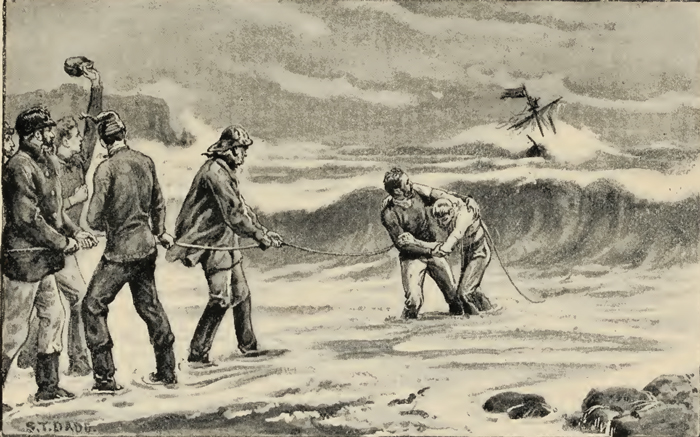
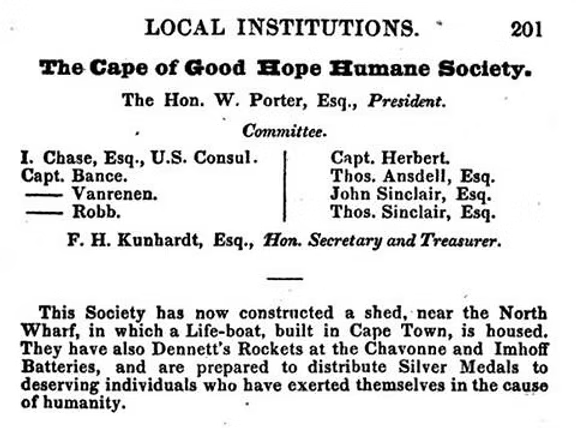
A short-lived Humane Society of the Cape of Good Hope existed between 1842 -1846 (see below). It had a boathouse near the North Wharf and Dennett Rockets, which could be used to send a lifeline to a stranded ship near the shore.
Humane Societies were superseded by lifesaving associations in the late 19th century.
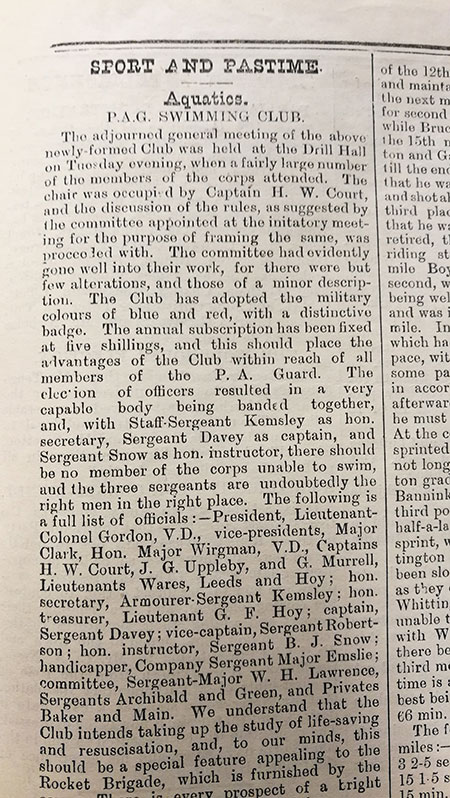
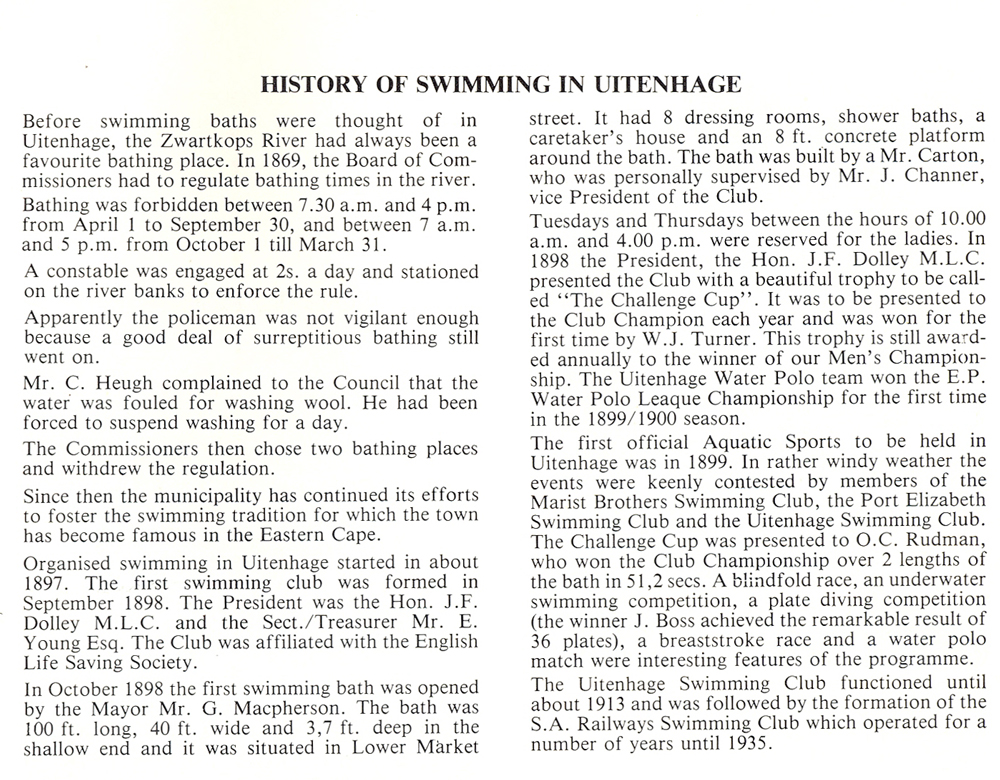
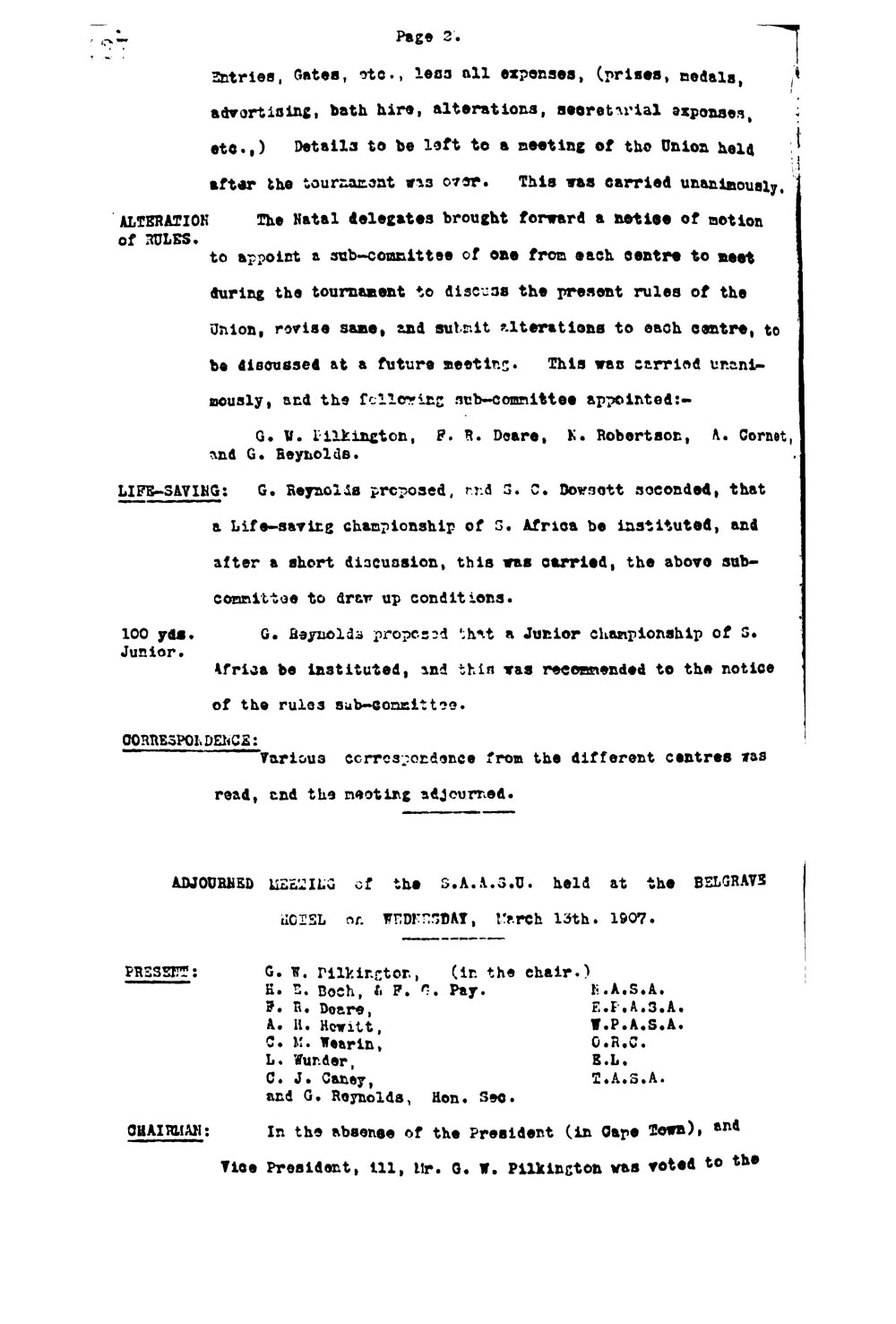
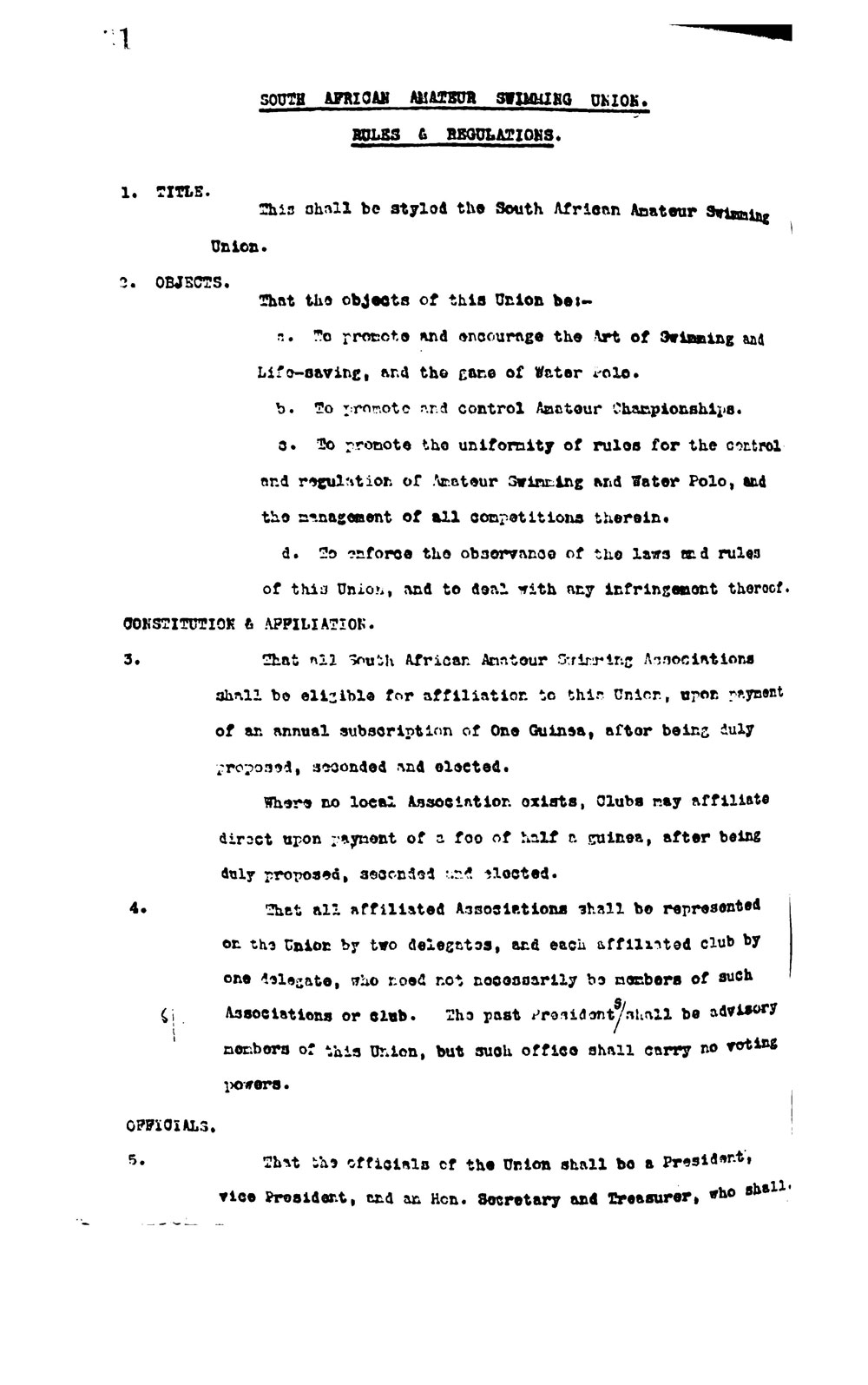
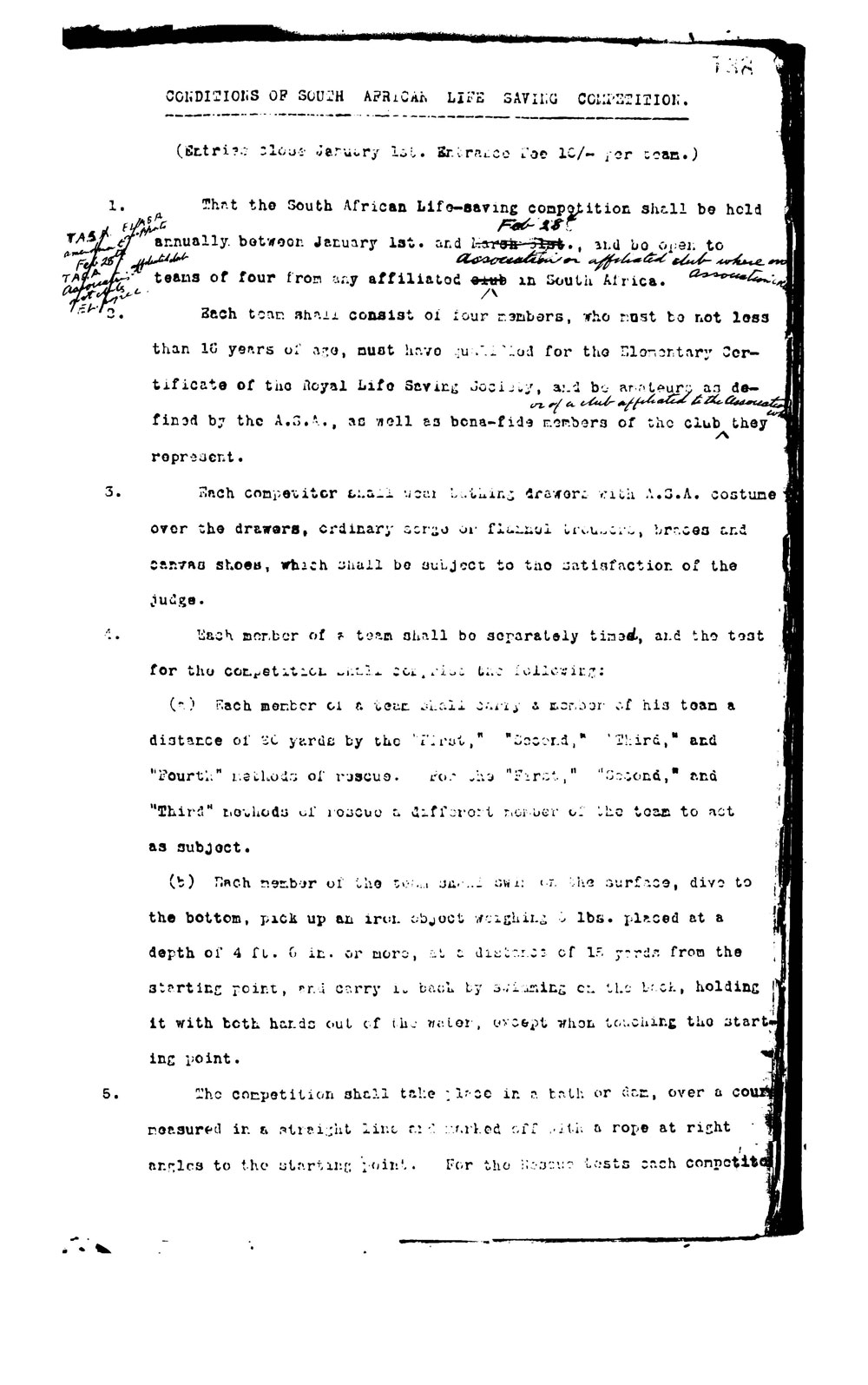
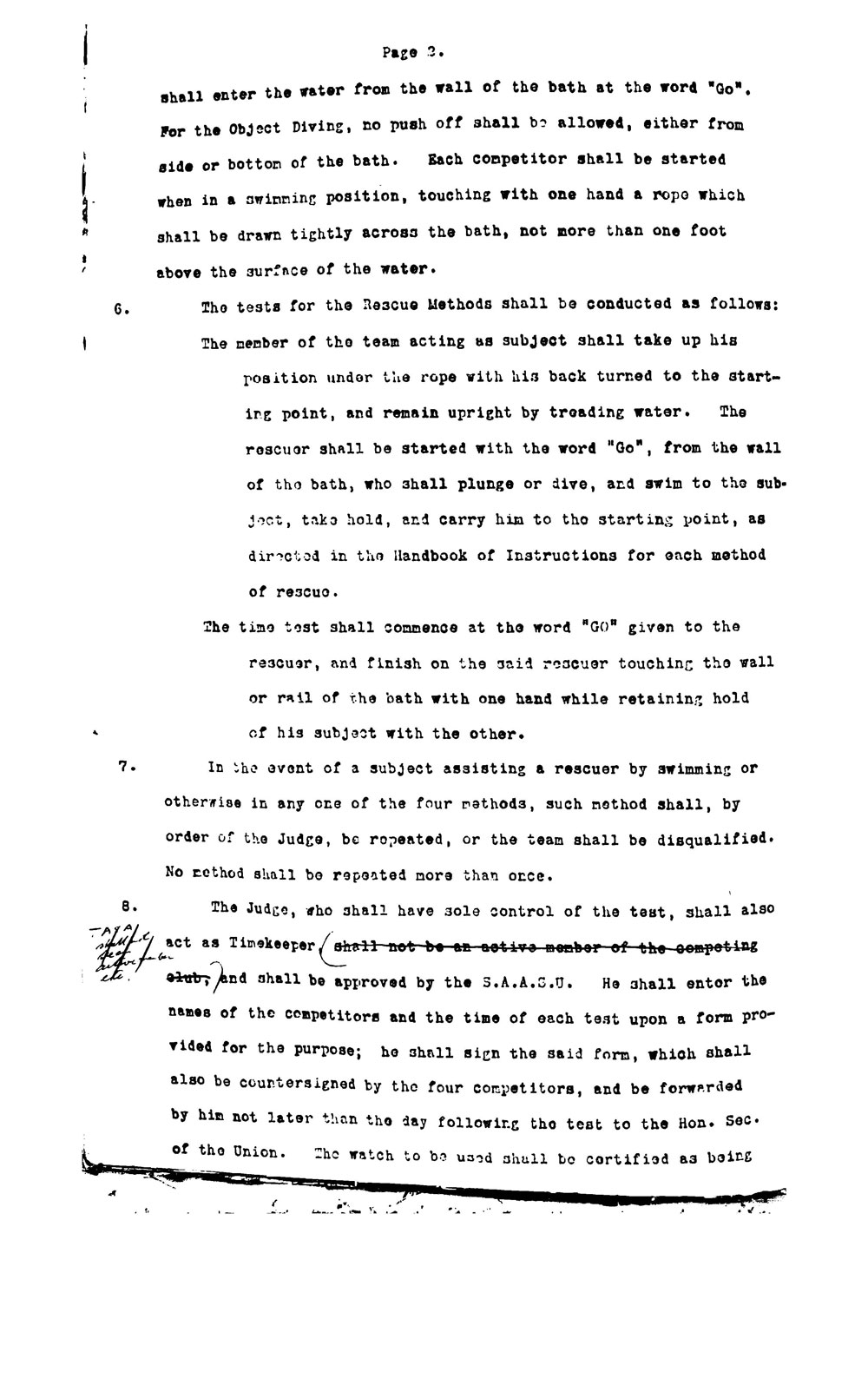
It was a stated objective (see images below) of 19th-century swimming clubs in South Africa to promote lifesaving. At a SAASU Meeting in 1907, the Union defined the rules for an inter-provincial annual lifesaving competition.
The two disciplines - still water and surf - lifesaving have been combined into one competitive sport.
This website simply shows how competitive lifesaving and swimming are related activities in South Africa. Lifesaving, as a public service, was a driving force behind the need to develop swimming skills to prevent drownings. Many people participated in lifesaving as well as other forms of aquatic sports like swimming or diving.
Traditionally, lifesaving was divided into still water lifesaving - rivers, dams and swimming pools- and surf lifesaving - in the ocean. The former has its origins in England, while surf lifesaving was born in Australia in the early 20th century. Both later developed a competitive side, with biennial world championships, while maintaining their public-service element.
In 2003, the various still water and surf lifesaving governing bodies united to form Lifesaving South Africa.
South African Lifesaving now consists of over 60 Surf Lifesaving Clubs strung along the whole South African coastline and over 50 Freshwater Clubs spread throughout South Africa.
The first Surf Lifesaving World Championships were held in Durban in 1974.
Today, the surf and still water elements have been combined and biennial international lifesaving championships are held for both surf and still water events.
Wolraad Woltemade
In 1773, a drama unfolded on Woodstock Beach in Cape Town when Wolraad Woltemade (65) rescued 14 sailors from a shipwreck. He became the most legendary lifesaver in South African history. The VOC named one of its ships De Held Woltemade; CJ Langenhoven wrote a poem; a large bronze statue commemorating his bravery was created in 1956; and the Woltemade Decoration for Bravery was instituted by Warrant of 20 May 1970 (below).
Seeing the storm-tossed ship and hearing the cries of the crew, Woltemade plunged his horse into the sea in an attempt at rescue. Although he himself could not swim, his horse was a strong swimmer and was able to reach close enough to the ship to bring two of the crew back to shore. Seven times Woltemade risked his life and that of his horse in the raging surf but on the eighth attempt so many people clung to him that the horse’s strength failed. They were overwhelmed by the waves and all were drowned.


Wolraad Woltemade - deur CJ Langenhoven










Surf Lifesaving
Springbok swimmers like Ricky Colepepper, Lee McGregor, Paul Blackbeard, Graham Hill, Nicky Gray, Tricia Butcher, Gary Brinkman - and many more - have also been surf lifesaving champions.
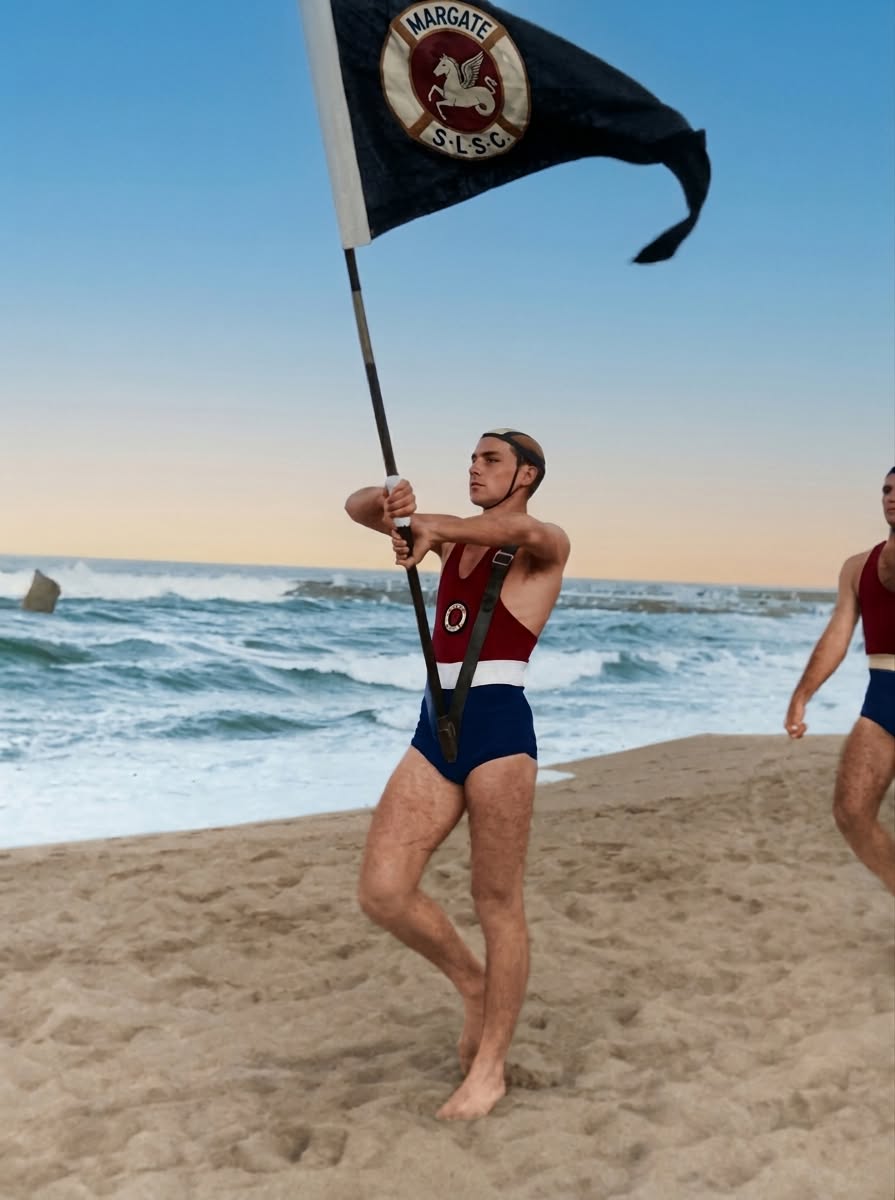
South African Surf Lifesaving began in Durban in 1927, shortly after visiting lifesavers from Australia paraded along the beachfront of Durban, demonstrated lifesaving techniques and encouraged the formation in Durban of the first two clubs, the Durban Surf Life Saving Club - Durban Surf is the only non-Australian club to have ever won the World Title, and they did it not once but twice - and the Pirates Lifesaving Club.
Another famous South African surf lifesaving club is Warnadoon Club, on the Natal South Coast, which was the next of several clubs to be formed during the following years and in 1933 the Lifesaving Clubs formed the Surf Lifesaving Association of South Africa, consisting of four Provincial Associations.
As early as 1913, the Royal Life Saving Society had formed its first South African Branches for teaching and certifying its lifesaving techniques at swimming pools and inland waterways.
In 1961 it was reconstructed as the South African Lifesaving Society, and in 1979 the name of the Society was again changed to the South African National Water Safety Council.
In 1980 the South African Surf Lifesaving Union was formed to serve the cause of certain clubs who opposed the Government of the day and consisted of three Provincial Associations.

Still Water lifesaving
Early swimming galas and carnivals usually included lifesaving events, where competitors demonstrated various techniques and performed staged rescues against a clock. Many South African schools have taught lifesaving, and pupils completed the Royal Lifesaving Society certification courses - some still do today. Inter-provincial lifesaving championships were held for both forms, and especially during the 1970's and 80's, Springbok still water teams competed in Europe, while surf lifesavers went to Australia, New Zealand and the USA. In 1774, the English Royal Humane Society was founded to combat ignorance and superstition; investigate and discredit inadequate methods of resuscitating the apparently drowned. They were concerned at the number of people wrongly taken for dead - and, in some cases, buried alive.
The Humane Society - then called the 'Society for the Recovery of Persons Apparently Drowned' - set out 5 key aims:
- to publish information on how to save people from drowning
- to pay 2 guineas to anyone attempting a rescue in the Westminster area of London
- to pay 4 guineas to anyone successfully bringing someone back to life
- to pay 1 guinea to anyone - often a pub-owner - allowing a body to be treated in his house
- to provide volunteer medical assistants with some basic life-saving equipment
A 2011 email from the Secretary of the Royal Humane Society states as follows:
A list of Humane Societies’ dates of establishment which has “Cape of Good Hope 1842”, which suggests there was at least one club in SA but I have no further info.
The RHS had a number of representatives in the Union of South Africa who would report cases direct to us, and awards were made from London. They were in Bloemfontein, Cape Town, Durban, E London, Grahamstown, Jo’burg, Kimberley, Mossel bay, Natal (Margate), Natal (Pt Edwards), Port Alfred, Port Elizabeth, Port St Johns and Pretoria. Awards ceased to be given to SA in 1950. From 1955 there was correspondence about an attempt to form a Society but nothing appears to have come of it. There were further letters initiated by Willem Steenkamp of the President's Council in 1992 but that correspondence also petered out. My predecessor wrote to South African Lifesaving, 35 Livingston Road, Durban 4001 in Dec 1996 but received no reply.
Cape of Good Hope Almanack and Annual Register for 1846
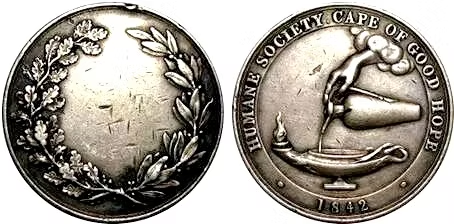
https://www.wcnumsoc.com/cape-of-good-hope-medal-humane-society
THE CAPE OF GOOD HOPE HUMANE SOCIETY AND ITS MEDAL'
By A.N. Pamm
The History of the Cape of Good Hope Humane Society
The Cape of Good Hope Humane Society was founded in June 1842 and dissolved in February 1846. It was based in Cape Town in what was then the Cape Colony, South Africa. From 1842 to 1845 the Society was financed by public subscriptions to the tune of £147 (as £80 per annum had been originally promised this was a shortfall of approximately £173 over four years) and £209 from special donations and fundraising activities.
With these funds the Society constructed a boatshed near the North Wharf, Cape Town and had a lifeboat built in Cape Town. Dennett's Rockets were acquired and positioned at the Chavonne and Imhoff Batteries. Also acquired (as a gift from the Royal Humane Society of London in 1845 was a resuscitation apparatus lodged at Somerset Hospital.
On dissolution, these assets were given to the Colonial Government and the sentiment was expressed, "that the successful establishment of effective means to render assistance to vessels in distress can alone be accomplished by the appointment of permanent officers for such service under responsibility to the Colonial Government".
The Society had seen its public subscriptions decline over the four years of its existence and despite, "much individual effort" had not been able "to establish an effective scheme to afford relief in such distressing events as have been witnessed since June 1842". What had been done over that period (during which time four shipwrecks with attendant loss of life had occurred) had "been the efforts of but comparatively few of the inhabitants of Cape Town".
The Committee members of the Society were; Hon. W. Porter (President), I. Chase (U.S.Consul), Captain Bance, Captain Vanrenen, Captain Robb, Captain Herbert, Thomas Ansdell, John Sinclair, Thomas Sinclair, and F.H. Kunhardt (Hon. Secretary and Treasurer)
The Dennett rockets, ordered in July 1842, were deposited in the magazines of the Imhoff and Amsterdam Batteries with a promise of assistance from the Artillerymen. Subsequently, a letter dated 1 June 1843 was received from the Colonial Office stating "that it would interfere with the military avocations of the Artillerymen to charge any of them with the duty of proceeding to the spot in the event of shipwreck for the purpose of firing the rockets".
The Dennett Apparatus was lodged at the Port Office and was subsequently taken in charge, together with the rockets of the Imhoff Battery, by the Secretary of the Society in June 1845 when a rocket firing trial was successfully conducted with the assistance of the Artillery Corps. The rockets at the Amsterdam Battery remained there. From this, it appears that, although present, the rockets were not effectively available for shipwreck service during most of the lifetime of the Society.
Early on in its life the Committee initiated efforts to determine the most suitable type of lifeboat and to procure one. Impetus was given by the loss of the convict ship Waterloo with 194 lives on 20 August 1842, and approaches were made to the local firm of Herbert & Bryant, who had the requisite theoretical knowledge but not the requisite practical experience to build a lifeboat. Appeals were addressed to both the Lords of the Admiralty and the Royal Humane Society, and the following is a copy of an extract from the latter's Committee Minutes.
The above is an extract from the Minutes of the Meeting held on 21st December 1842 and for clarity is reproduced as follows:
"Letters read from
H. Kunhardt Esq Cape Town:
asking for a Life Boat &c upon the establishment of a Humane Society at the Cape of Good Hope.
Resolved
That the apparatus with the Methods of Treatment of this Society be presented to the Cape of Good Hope Institution, but that the funds will not admit the gift of a Life Boat"
Whilst the main Cape of Good Hope Committee were still indecisive a separately constituted committee acting upon public pressure for the purpose gave the 'go ahead' for the lifeboat, which was received in May 1843 and for which the Society then purchased a floating apparatus, oars, anchor and other appurtenances. A boathouse was then constructed costing £91.
Negotiations continued in July and August 1843, with the Admiralty, for the acquisition of a second lifeboat, suitable for service in Table Bay, from England. A response was received in April 1844 to the effect that the Lords of the Admiralty could only grant a lifeboat if recommended by the Colonial Government. As had been mentioned earlier, the Royal Humane Society had also declined to send a lifeboat, but had promised the gift of a resuscitation apparatus which took some two years to arrive at the Cape as the following extract from Royal Humane Society records shows:
The Royal Humane Society's Letters Book, May 1844— July 1845, p. 24, states:
"F.H. Kunhardt
Secretary to C.G.H.H.Soc
Cape Town
Cape of Good Hope
June 10 / 44
Sir
With reference to the letter address'd to Mr Sinclair in Decr 1842 by my Predecessor, in which is notified the intention of this Institution presenting to the Humane Society establish'd at the Cape of Good Hope the apparatus for the Recovery of the Apparently Drown'd or Dead, but which had been delay'd until now in order to test the efficiency of some alterations made in the same. I have much satisfaction in forwarding Herewith a complete set of the resuscitating Apparatus with the recent improvements together with a few copies of the Methods of Treatment and a copy of the last Annual Report.
And remains &c J. Charlier Secretary."
A copy of the original from the Royal Humane Society's Letter Book is shown on the following page.
Contemporary reports do not mention any use of the lifeboat built in Cape Town until June 1845, when an efficiency trial was conducted which showed that the seals on the boat were "too low for purchase on the oars".
At this time the Cape of Good Hope Humane Society's Secretary realised the "indispensable necessity for the appointment of a permanent officer for the care and management of the boat and its occasional practice".
By this time also the Society's funds had been exhausted, and a fresh public appeal was made which attracted the attention of the Secretary to Government, Mr Montague. An amount of £50 per annum was estimated for "the salary of a manager to the lifeboat, for the periodic practice of a crew and for the periodic practice of the rockets and their expense", and the Colonial Government included the provision of this amount to the Humane Society in its published estimates of expenditure for the year 1846.
Following this promise of financial support, the Secretary unsuccessfully advertised for a suitably qualified Boatman to steer and manage the boat and crews during periodic practices and in cases of emergency.
Eventually, in the absence of more suitable applicants, a fisherman named Boonzayer was appointed. The paid crew would come from the local fishermen who were generally without employment during the northwesterly gales which were the greatest cause of danger to shipping. The boat and crew were to practice monthly and were, "to proceed day or night immediately to any vessel requiring assistance".
The first trial, scheduled for 26th December 1845, did not take place because Boonzayer happened to be indisposed that day.
By January 7th 1846 the "necessary alterations in the boat, the raising of the seals was finished", and the boat had been cleaned and partly prepared for a new coat of paint.
On the 7th January 1846 there was 'the melancholic occurrence of the loss of the Francis Spraight which gave rise to a Committee of Inquiry appointed by His Excellency the Governor.
On the 7th February 1846 the Society dissolved itself. The dissolution process was completed by April 1846 by when the Society's assets, tendered to the Colonial Government, had been transferred to the Port Captain.
The Medal of the Cape of Good Hope Humane Society
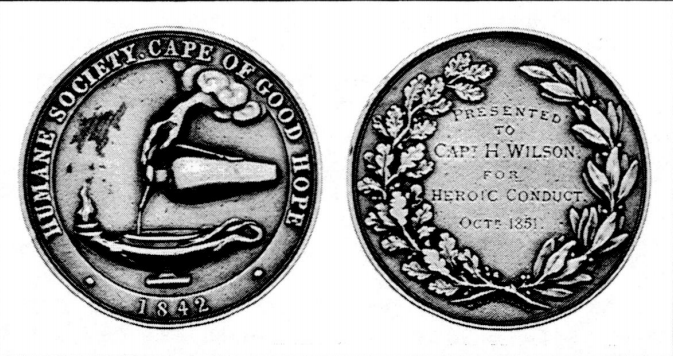
The medal illustrated above was awarded to Captain H. Wilson (see c) below.
- a) Description of the Medal Manufacturer: Struck in: Obverse: Reverse: Size: Naming: Suspension: W.W. 27 Strand (William Warrington). Silver Issuing from clouds a hand pouring oil from a pitcher into a burning lamp symbolising life. Legend: "Humane Society, Cape of Good Hope". Below "1842" A wreath of oak and laurel. A circular medal, 1.75 inches (45mm) in diameter, Details of recipient and date engraved on reverse None
- b) History of the Medal 1842-1846
In July 1842 the Society ordered "50 silver medals with a suitable design for distinction, and as a token of their sympathy to such individuals, who should prominently exert themselves in the cause of humanity, for which exertions your committee opined that pecuniary awards would be spurned which besides they knew they could not promote".
The Society's listing in a local Cape almanack showed it as being "prepared to distribute Silver medals to deserving individuals who have exerted themselves in the cause of humanity".
Upon dissolution in February 1846 the Society tendered to the Colonial Government "fifty silver medals with a suitable design to reward individual meritorious efforts in the cause of humanity".
As 50 medals were ordered in July 1842 and 50 medals were given to the Colonial Government in 1846, it is reasonable to assume that no awards of the medal were actually made during the lifetime of the Society.
c) Known Specimens of the Medal
- An unnamed specimen seen in a prominent Capetonian collection in the 1960s.
- A specimen, (ex Dr Payne Collection), inscribed "G. Johnson / voted /17 May 1868".
- A specimen in the Spink Auction of 30-11-2000 engraved "Presented to Capt. H. Wilson for Heroic conduct Octr. 1851".
- d) Usage of the Medal post February 1846.
Although two specimens with naming and award dates of 1851 and 1868 are known, it would be unsafe, until reliable supporting evidence presents itself, to assume that these were 'legitimately' awarded and are not the result of 'spurious naming details being added to unawarded specimens to enhance their saleability'.
The medal bears the struck name of the 'Humane Society, Cape of Good Hope' which would make inappropriate its usage by another body.
Medals were awarded by the Shipwrecked Fishermen & Mariners Royal Benevolent Society (of the UK) for rescues in Cape Colony during 1854, 1857, 1860 and 1864. Some of these awards were made on the recommendation of the Governor of the Cape Colony as forwarded to the Secretary of State for the Colonies. Additionally, one medal recipient in 1857 received a Testimonial from the Citizens of Cape Town. These awards point to the absence of a suitable local award in medallic form.
Acknowledgement:
Royal Humane Society
Sources:
Government Archives, Cape Town. "Letters (Jan 10th1846 & Apr 10th1846) & Report to Hon. Montague, Sec to Government, from F.H. Kunhardt, late Sec & Treasurer H. Soc. Pamm, A.N., Honours and Rewards in the British Empire and Commonwealth, Scolar Press, 1995, ISBN 0 85967 911 X. Royal Humane Society, Committee Minutes Book, Nov 1835-Dec 1842, pp.362 Royal Humane Society, Letters Book, May 1844-Jul 1845, pp.24
https://lsars.org.uk/site/journals.php